
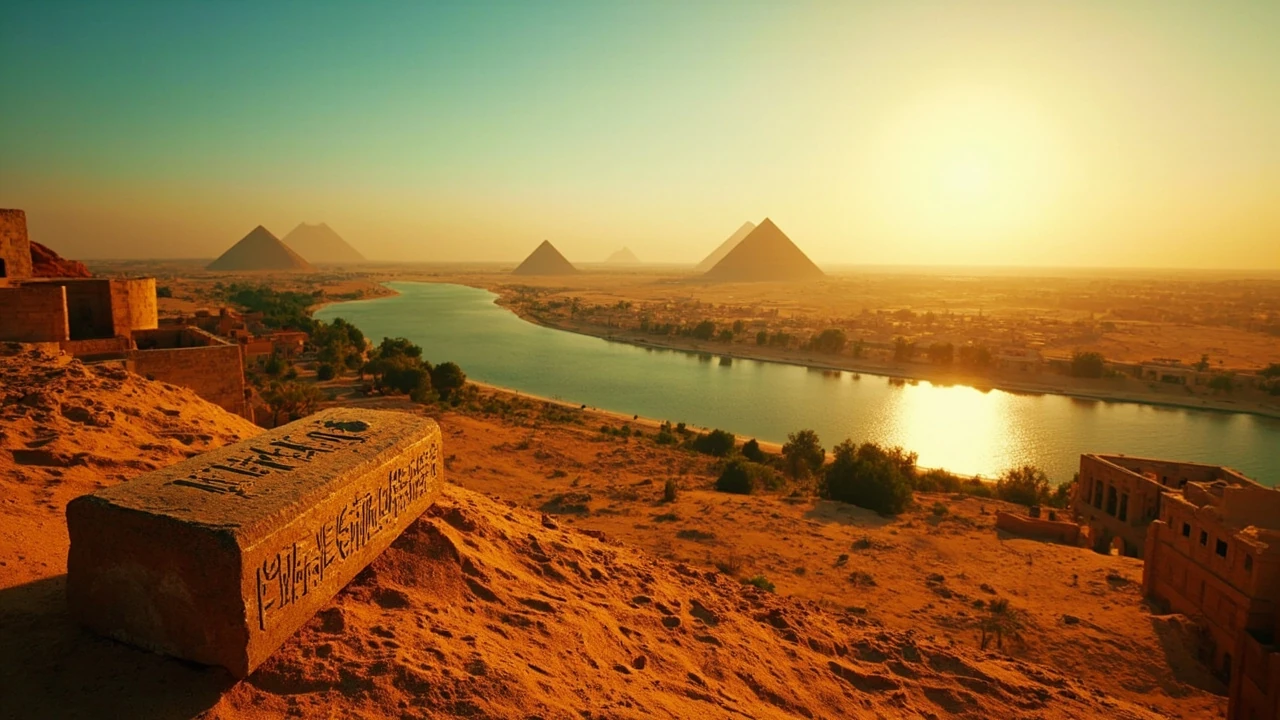
Egypt history timeline: A journey through 5,000 years
A traveler standing before the Giza pyramids is looking at more than an ancient construction project. The stones belong to a political system, a religious worldview, and a civilization whose influence reached far beyond the Nile Valley. An egypt history timeline helps place those monuments within the larger story of settlement, unification, imperial expansion, foreign conquest, religious change, and the creation of a modern republic.
The story begins with communities that settled along the Nile, developed agriculture, and created increasingly organized societies. It then moves through the age of the pharaohs, interrupted periods of division, the rise of an empire in the New Kingdom, Persian and Greek rule, Roman administration, Islamic dynasties, Ottoman control, British occupation, and the political changes that ultimately produced the modern state.
Dates for ancient Egypt are approximate because they are based on surviving inscriptions, archaeological evidence, and historical reconstructions. Several major transitions also occurred over long periods rather than on a single day. Even so, the broad sequence is clear: the Nile environment made settled life possible, political institutions grew around the river, and later generations repeatedly reshaped Egypt while preserving, adapting, or contesting its older traditions.
| Period | Approximate dates | What changed | Places associated with the period |
|---|---|---|---|
| Predynastic Egypt | Before about 3150 BC | Nile communities developed farming, settled communities, craft traditions, and early writing. | Nile Valley, Merimde, Badari, Naqada |
| Early Dynastic and Old Kingdom | About 3150–2200 BC | Upper and Lower Egypt were unified, dynasties developed, and pyramid building flourished. | Memphis, Saqqara, Giza, Dahshur |
| Middle Kingdom | About 2040–1650 BC | Political disruption was followed by reunification, stability, territorial expansion, and cultural development. | Thebes, Avaris, Beni Hasan |
| New Kingdom | About 1550–1070 BC | Egypt became an international power under rulers including Ahmose I, Hatshepsut, Thutmose III, and Ramesses II. | Thebes, Luxor, Karnak, Abydos, Abu Simbel |
| Late Period and foreign rule | About 1070–332 BC | Libyan, Nubian, Assyrian, and Persian powers competed for control. | Sais, Tanis, Memphis, the Delta |
| Ptolemaic and Roman periods | About 332 BC–641 AD | Alexandria became a major center of Hellenistic and Roman culture, administration, trade, and scholarship. | Alexandria, Memphis, Oxyrhynchus, Antinoöpolis |
| Islamic and Ottoman periods | About 641–1867 | Egypt became part of wider Islamic empires while Cairo developed as a major political and cultural center. | Fustat, Cairo, Giza, the Nile Delta |
| Modern Egypt | From the 19th century onward | British influence and occupation led to nationalist movements, independence, revolution, republican government, and continuing political development. | Cairo, Giza, Alexandria, Port Said, Suez |
This chronology is best used as a map rather than a list of disconnected dates. Architecture can reveal how rulers governed, religion can show how communities understood power, and changes in language or administration can mark the arrival of new political traditions.
Before the pharaohs: life develops along the Nile
Around the sixth millennium BC, communities in the Nile Valley were developing Neolithic cultures. Farming gave them a more stable food supply, while the river’s geography encouraged settlement along the valley and delta. The environment was not simply a backdrop. Annual flooding deposited fertile soil, waterways supported transport, and the contrast between the productive valley and surrounding desert concentrated people and resources in a relatively narrow corridor.
The earliest known Lower Egyptian site mentioned in the supplied historical evidence is Merimde, which predates the Badarian culture by roughly seven centuries. In Upper Egypt, the Badari culture was followed by the Naqada sequence. These communities were not identical, but they exchanged goods, ideas, and people. Regional cultures developed over long periods rather than appearing suddenly as a finished civilization.
Writing is one of the most important markers in this early history. The earliest known hieroglyphic inscriptions appeared on Naqada III pottery around 3200 BC, close to the period of unification. Such signs helped rulers and administrators record names, events, and relationships. They also supported a growing distinction between religious practice and royal administration.
- Environmental foundation: The Nile supported farming, fishing, transport, and concentrated settlement.
- Cultural development: Archaeological evidence points to distinct Lower and Upper Egyptian communities with continuing contact.
- Political organization: Larger settlements supported increasingly specialized crafts, ceremonies, and administrative institutions.
- Written records: Early hieroglyphs appeared shortly before the first dynasty and became essential to royal government.
For travelers, the significance of the predynastic period is easiest to appreciate where the evidence is still archaeological rather than monumental. Saqqara and the areas around the Nile Valley reveal that Egypt’s famous pharaonic civilization did not spring into existence fully formed. It grew from older communities, experiments in settlement, and forms of communication that later pharaohs would refine.
Unification begins the dynastic age
Around 3150 BC, Upper and Lower Egypt were brought together under a royal system associated with King Narmer, also called Menes in later tradition. The unification is often treated as the conventional beginning of dynastic Egypt, although the process should not be imagined as a single instant event. Political consolidation, ritual change, and the spread of royal authority developed across the region.
The new kingdom established a pattern that would last for roughly three millennia: centralized kingship, a court, hereditary dynasties, monumental building, and an administrative system that relied on written records and taxation. Egypt’s geography supported this political order. Unlike a state centered on one city, the royal system had to connect the Delta, the valley, and settlements extending toward Nubia and neighboring regions.
The Early Dynastic Period consolidated the new monarchy. The Old Kingdom, conventionally dated around 2700–2200 BC, became famous for pyramid building. Step pyramids and later true pyramids developed from royal funerary complexes that also included temples, causeways, tombs, and subsidiary structures. Djoser’s complex at Saqqara and the Giza pyramids associated with Khufu, Khafre, and Menkaure demonstrate the scale of Old Kingdom organization.
| Development | Period | Historical meaning | Traveler-friendly evidence |
|---|---|---|---|
| Political unification | About 3150 BC | A royal order connected Upper and Lower Egypt and established dynastic rule. | Early royal remains and inscriptions associated with Abydos and Saqqara |
| Old Kingdom pyramid building | About 2700–2200 BC | Royal authority and organized labor supported large funerary complexes. | Step Pyramid of Djoser, Giza pyramids, Dahshur |
| Middle Kingdom reorganization | About 2040–1650 BC | Stability returned after political upheaval and Egypt expanded into Nubia. | Beni Hasan tombs and the expanding royal centers of the south |
| New Kingdom imperial power | About 1550–1070 BC | Egypt projected military and political influence from Syria toward Upper Nubia. | Temple of Karnak, Abu Simbel, the Valley of the Kings |
| Late Period competition | About 1070–525 BC | Libyan and Nubian dynasties governed Egypt before Persian conquest. | Tanis, Sais, and temples that record changing royal identities |
Monuments also require caution. They present the official version of royal power, not a complete record of every community. A pyramid’s scale can reveal the resources the court commanded, but it cannot by itself tell us what every farmer, craft worker, soldier, or local community experienced. The egypt history timeline becomes more useful when monumental evidence is compared with settlements, objects, written records, and the changing physical landscape.
Old Kingdom, division, and the Middle Kingdom
The Old Kingdom combined strong central authority with monumental construction, yet it did not remain politically unchanged. The period before the First Intermediate Period included shifts in royal administration and evidence of instability at the end of the Sixth Dynasty. The broader transition should be understood as a breakdown in centralized coordination rather than a disappearance of Egyptian society.
The First Intermediate Period lasted about 150 years, although the chronology varies by definition. Regional rulers competed, and political authority was less consistent than in the Old Kingdom. Stronger Nile floods and the stabilization of government were associated with renewed prosperity during the Middle Kingdom, which began around 2040 BC.
The Middle Kingdom restored unity and developed institutions that supported further expansion. Egypt’s attention turned increasingly toward Nubia to the south. Amenemhat III, whose reign is identified in the supplied historical evidence as a peak point of the Middle Kingdom, is especially associated with extensive building projects and a fortified border landscape in Lower Nubia.
Administrative documents from this period provide unusually detailed evidence about how the state operated. The preserved accounts associated with the Hekanakhte papers illustrate the management of land, labor, livestock, and taxation in a local administrative setting. Rather than describing the entire kingdom from a royal monument, they reveal how obligations and resources moved through the system.
- Authority weakens: The Old Kingdom’s centralized order gives way to political upheaval and competing centers of power.
- Government stabilizes: Conditions improve and a reunited government reasserts control during the Middle Kingdom.
- The frontier expands: Egyptian officials and military forces extend their reach into Nubia.
- Administration records change: Documents such as the Hekanakhte papers reveal more about the everyday operation of royal institutions.
The Middle Kingdom was followed by the Second Intermediate Period. The Hyksos, described in the supplied historical evidence as migrants from a Semitic-speaking group, took control of much of Lower Egypt around 1650 BC and established a capital at Avaris. Their rule is often connected with new forms of warfare and administration, including the increased use of composite bows and chariots in the eastern Mediterranean world.
Native Egyptian forces eventually drove out the Hyksos. Ahmose I founded the Eighteenth Dynasty and shifted the royal center from Memphis toward Thebes. This was more than a change of capital. The rebellion initiated the New Kingdom and restored an expansive vision of Egyptian kingship.
The New Kingdom brings imperial power
The New Kingdom began around 1550 BC with the Eighteenth Dynasty. It is often the most familiar period of pharaonic history because many surviving temples, tombs, inscriptions, and royal monuments belong to it. Rulers such as Hatshepsut, Thutmose III, Akhenaten, Nefertiti, Tutankhamun, and Ramesses II became central figures in both academic study and popular accounts of ancient Egypt.
Egypt’s influence extended from Syria in the northeast toward Upper Nubia in the south. The supplied historical evidence describes the New Kingdom as the period when Egypt became an international power. Military campaigns delivered tribute and resources, while royal building projects expressed the pharaoh’s authority at home. Karnak, Luxor, Abydos, and Abu Simbel are not merely tourist sites; they are records of diplomacy, warfare, ritual, and royal ideology.
Hatshepsut’s reign illustrates how the relationship between ruler and image could be presented to visitors. Her monuments and statues emphasize legitimate rule within the conventions of Egyptian kingship. Thutmose III’s campaigns, by contrast, are associated with a sustained effort to expand Egyptian influence in the Levant and beyond. These rulers were not identical in policy, but each operated within institutions that linked kingship to military and ceremonial power.
Akhenaten’s reign introduced a dramatic religious change. The worship associated with Aten became the focus of royal policy, and temples devoted to earlier gods were closed or altered. The Amarna period also changed artistic conventions, including the elongated forms and intimate family scenes seen at Amarna. After Akhenaten’s death, the restoration of traditional religious practices became associated with Tutankhamun and later rulers.
- Political expansion: Campaigns and diplomacy extended Egyptian influence from Syria toward Upper Nubia.
- Monumental construction: Temples and tombs recorded royal achievements and reinforced the pharaoh’s role.
- Religious experimentation: The Aten-centered policy of Akhenaten briefly changed state worship and artistic representation.
- Continuity after disruption: Later rulers returned to older traditions while preserving many New Kingdom institutions.
The New Kingdom declined after about 1070 BC. Administrative weakness, changing royal centers, and competing foreign powers contributed to the Third Intermediate Period. Libyans, Nubians, and Assyrians entered or contested Egyptian territory. The Twenty-Fourth Dynasty, based at Sais, represented Libyan political control, while the Twenty-Fifth Dynasty was Nubian. The supplied evidence notes that native Egyptian forces eventually drove out foreign rulers and regained control, but the process involved shifting alliances and prolonged competition rather than a simple national uprising.
The earliest chapters of Egyptian history are not recorded by pharaohs. They are reconstructed through archaeological traces left by communities that lived along the Nile and in nearby oases. Evidence includes rock art, tools, pottery, animal remains, burials, settlements, and the earliest forms of hieroglyphic inscription. The surviving historical overview of Egypt describes evidence of petroglyphs along Nile terraces and in desert oases, as well as hunter-gatherer and fishing communities that eventually gave way to a grain-based agricultural culture.
By the Late Period, Egypt was again independent under native rulers, only to face renewed Persian conquest in the sixth century BC. The sequence shows how stability and fragmentation could alternate without erasing Egypt’s underlying religious, administrative, and artistic traditions.
Persian, Greek, and Roman periods reshape Egypt
The Achaemenid Persian Empire conquered Egypt in 525 BC. The Twenty-Seventh Dynasty remained Persian-ruled for most of the period from 525 to 402 BC, with Persian kings taking the title of pharaoh. Local rebellion ended the first phase of Persian control, but native dynasties returned. The last native pharaoh of the pharaonic epoch, Nectanebo II, was defeated by the Persians in 343 BC, beginning a short Second Persian period that lasted until 332 BC.
The Persian periods are important because they show that Egyptian kingship could survive within a larger imperial system. Local temples, administrators, and communities continued to function, while royal authority came partly from an external power. This arrangement differed from earlier periods of division because Egypt remained part of a connected imperial administration.
Alexander the Great’s conquest in 332 BC initiated the Ptolemaic era. The Ptolemies ruled from Alexandria, a city that became a center of Greek culture and trade. At the same time, they presented themselves as legitimate pharaohs, adopted Egyptian religious customs, appeared in Egyptian styles on monuments, and participated in Egyptian ceremonies. Their rule therefore combined Greek political forms with established traditions of Egyptian kingship.
Alexandria’s intellectual and commercial importance continued under Roman rule. Egypt supplied a large share of the Roman Empire’s grain along with flax, papyrus, glass, and other finished goods. Ships regularly carried goods toward destinations including India and Ethiopia. The supplied evidence also describes Alexandria as one of the empire’s leading scientific and technological centers, with scholars associated with the city including Ptolemy, Hypatia, and Heron.
Under Rome, Egypt became a major province, but local institutions and identities did not simply disappear. The comparison with another long historical destination, Greece history is bigger than Ancient Athens, shows why regional history is essential. Greek influence in Egypt cannot be separated from the local communities, Egyptian religious traditions, administrative structures, and geography that gave those influences meaning.
| Period | Political center or ruling power | Important developments | Lasting legacy |
|---|---|---|---|
| First Persian rule | Achaemenid Empire | Persian kings adopted the title of pharaoh; local rebellions challenged direct control. | Egypt became part of a wider imperial system while retaining distinct institutions. |
| Second Persian rule | 343–332 BC | Nectanebo II was defeated, ending the last native dynasty of the pharaonic epoch. | The political tradition shifted toward Macedonian and Hellenistic rule. |
| Ptolemaic period | Alexandria | Greek-language monarchy blended with Egyptian royal and religious traditions. | Alexandria developed as a major center of trade, learning, and Hellenistic culture. |
| Roman period | Roman imperial administration | Egypt supplied grain and manufactured goods and remained a key Mediterranean province. | Routes to the Red Sea and Indian Ocean strengthened Alexandria’s commercial role. |
| Byzantine period | Eastern Roman Empire | Christian institutions expanded while older administrative and economic practices continued in modified forms. | Alexandria and the monasteries of the desert remained major centers of Christianity. |
Cleopatra VII’s defeat and death in 30 BC marked the end of the Ptolemaic dynasty and the beginning of direct Roman rule. The transition is a familiar dividing line, but the deeper change involved government, taxation, landholding, military power, and the reorientation of Egypt’s economy toward Rome. Greek and Egyptian cultural traditions continued side by side, as did the native Coptic cultural tradition and the Coptic language.
Islamic Egypt, Cairo, and Ottoman rule
After the Byzantine period, Arab armies conquered Egypt beginning in the 640s. Over subsequent centuries Egypt became one of the intellectual, economic, and political centers of the Islamic world. The change did not erase older communities or artistic practices, but it placed Egypt within new religious and governmental frameworks.
Fustat, founded in the seventh century, became an important early capital. Under the Fatimids, Cairo emerged as a major center of power, trade, learning, and monumental architecture. The Al-Azhar Mosque, founded in the tenth century, became associated with education and religious scholarship. Mamluk rule from the thirteenth century brought another phase of political and architectural development, while Ottoman governors expanded their control after Egypt’s incorporation into the Ottoman Empire in 1517.
The later Ottoman period included significant demographic and economic changes, especially during the nineteenth century. Egyptian rulers pursued military modernization, European investment expanded, and the country became increasingly entangled in European political ambitions. Muhammad Ali’s dynasty strengthened the state in the early nineteenth century, but financial and military pressures grew.
France’s military intervention in Egypt in 1798 and the British occupation in 1882 were two different imperial episodes with long consequences. British rule brought administrative restructuring, infrastructure, and major changes to the economy. It also provoked organized Egyptian nationalism, particularly after World War I. The nationalist movement challenged British political influence and the sovereignty of the monarchy.
- Arab conquest and early Islamic rule: Egypt joined the expanding Islamic empires and developed new centers of government and scholarship.
- Fatimid and Mamluk periods: Cairo became a prominent center of political authority, trade, architecture, and religious learning.
- Ottoman integration: Egypt entered the Ottoman Empire in 1517 and remained under Ottoman administration for centuries.
- European intervention: French military action and British occupation reshaped Egypt’s government, economy, and foreign relations.
- Nationalist challenge: Egyptian movements demanded greater independence and challenged British control and the old political order.
For visitors, this period explains why Egypt’s architecture and urban life combine Islamic, Coptic, Mediterranean, and modern European elements. Cairo’s historic quarters, mosques, minarets, churches, and museum collections are not separate stories. They are layers created as different rulers and communities adapted the same place.
The modern republic and Egypt today
The 1919 revolution and the protests surrounding it intensified the nationalist challenge to British influence and the monarchy. Egypt became formally independent in 1922, although British military presence and treaty arrangements complicated the meaning of sovereignty. The 1923 constitution established a parliamentary monarchy, and the royal family continued to exercise formal authority.
Political disagreements, economic strain, military politics, and the Palestine war contributed to the collapse of the monarchy. The Free Officers Movement seized power in 1952, ending the royal system. The Republic of Egypt was formally proclaimed in 1953. Under Gamal Abdel Nasser, the government ended the British military presence, nationalized the Suez Canal Company, and established a republic that became a leading Arab state in regional and international affairs.
Nasser’s death in 1970 was followed by a political transition under Anwar Sadat. Sadat’s government concluded the Camp David Accords with Israel in 1979, the first such treaty between Israel and an Arab state. Egypt’s diplomatic alignment changed, and the country’s relationship with the Arab world became more complex. Hosni Mubarak’s presidency from 1981 to 2011 brought a long period marked by stability in some respects and by limited political openness.
Large-scale protests beginning in 2011 challenged Mubarak’s government and led to his departure. The transition that followed included elections, new constitutions, political realignment, and continuing disputes over authority, rights, security, and the role of the military. Abdel Fattah el-Sisi became president in 2014, and the supplied historical source identifies him as Egypt’s current leader.
The modern portion of the egypt history timeline is therefore not simply a list of leaders. It includes the end of a monarchy, the creation of a republic, debates over central authority and public participation, and Egypt’s changing role in the Middle East and global economy. Tourism and heritage also occupy a major part of the national economy, which creates continuing reasons to protect archaeological sites and manage the pressures associated with large numbers of visitors.
Events in the twenty-first century can make older-looking historical arguments seem less secure. A timeline should therefore distinguish the long-term pattern from any claim that recent developments have permanently resolved older tensions. Institutions, borders, population pressures, economic conditions, and political alliances continue to change, even when archaeological landmarks remain visible.
How to use the timeline when visiting Egypt
A historical timeline becomes more useful when it is connected to places. The order below gives a practical way to match major periods with destinations, but it is not a rigid itinerary. Travelers can use it to decide which sites answer the questions that interest them most.
- Begin in Cairo: The Egyptian Museum and the Giza plateau provide context for pharaonic institutions, royal artifacts, Old Kingdom construction, and later national history.
- Continue south to Luxor and Karnak: New Kingdom temples, royal sculpture, and tombs make the imperial period tangible.
- Compare Old Kingdom sites: Saqqara and Dahshur help explain the development of pyramid building beyond the most familiar monuments at Giza.
- Explore the Delta and Alexandria: Avaris, Tanis, Alexandria, and other Delta centers reveal the importance of the northern region and Hellenistic history.
- Allow time for the layers: Christian sites, mosques, Coptic neighborhoods, and Ottoman-era architecture show that Egypt’s history did not stop with the last pharaoh.
Travelers who prefer to understand a destination rather than collect attractions can use a structure similar to the one in Panama is much more than the canal: one landmark is rarely the whole story. A pyramid is not merely an answer to “how did Egyptians build it?” It is evidence of royal authority, labor organization, religious belief, stone technology, and the relationship between the court and the wider population.
Three questions can make any visit more rewarding:
- Who commissioned the site? Identifying the ruler, dynasty, or religious institution reveals the political purpose behind the monument.
- What period does it represent? Placing the structure on the timeline helps distinguish Old Kingdom restraint, New Kingdom imperial imagery, Ptolemaic Greek-Egyptian forms, or Islamic architectural traditions.
- What evidence is missing? Elite monuments often tell us more about rulers and temples than ordinary farmers, workers, women, or local communities.
The most rewarding reading of any site combines chronology with comparison. Comparing Giza with Saqqara shows how pyramid design developed. Comparing Karnak with a smaller provincial temple reveals how royal ideology spread. Comparing Coptic and Islamic sites in Cairo demonstrates continuity of place alongside changes in belief and government.
No timeline should imply that one period replaced another with no overlap. Egyptian institutions often survived under new rulers; local communities maintained practices while courts adopted foreign styles; and continuity could coexist with conquest. The dates provide orientation, but objects and places supply the evidence that makes history concrete.
Frequently asked questions
When did ancient Egypt begin?
Ancient Egypt is conventionally dated from the unification of Upper and Lower Egypt around 3150 BC and the beginning of dynastic rule. Its foundations were earlier, however. Settled communities had developed in the Nile Valley during the Neolithic period, and the predynastic Badari and Naqada cultures preceded political unification. When people say that Egyptian civilization “began,” they may therefore mean either the first royal state around 3150 BC or the much longer process of community formation along the Nile.
Who unified Egypt?
King Narmer is traditionally credited with unifying Upper and Lower Egypt around 3150 BC. Narmer is also known as Menes in later historical tradition. The unification probably developed over time rather than through one isolated event, but the royal polity associated with Narmer became the starting point for the dynastic sequence.
What was the Old Kingdom?
The Old Kingdom is generally placed around 2700–2200 BC. It is the best-known period of pyramid building and is associated with powerful centralized government. The Step Pyramid of Djoser at Saqqara and the Giza pyramids belong to this era. Its political system depended on administrators, local elites, farmers, craft workers, and laborers across the Nile Valley, so the monuments should not be understood as the work of a ruler alone.
What caused Egypt’s Intermediate Periods?
The Intermediate Periods were times of weakened central coordination, political competition, and division. The causes included shifts in royal power, regional rivalries, economic problems, and changes in control over valuable land and resources. The First Intermediate Period followed the Old Kingdom, while the Second included Hyksos rule over much of Lower Egypt. Both were followed by renewed political consolidation under native rulers.
Who were the Hyksos?
The Hyksos were a Semitic-speaking group that gained control over much of Lower Egypt around 1650 BC and established a capital at Avaris. Their period is often associated with the introduction or expanded use of composite bows and chariots in Egypt. Egyptian forces eventually expelled them, and Ahmose I began the Eighteenth Dynasty, opening the New Kingdom.
Which period was Egypt’s greatest imperial age?
The New Kingdom, approximately 1550–1070 BC, is commonly described as Egypt’s greatest period of international power. Its influence extended from Syria toward Upper Nubia. The reign of Thutmose III is particularly associated with military expansion, while monuments associated with Ramesses II, Hatshepsut, and other rulers helped define the period’s public image.
Did Egypt belong to the Roman Empire?
Yes. Egypt became a Roman province after the defeat of Cleopatra VII and the end of the Ptolemaic dynasty in 30 BC. It supplied the empire with grain, flax, papyrus, glass, and other products. Alexandria remained a major commercial and intellectual center with routes extending toward the Mediterranean, Red Sea, Ethiopia, and India.
When did Egypt become independent?
Egypt became formally independent from the United Kingdom in 1922, although British military presence and negotiated treaty rights continued to complicate full sovereignty. The monarchy was abolished in 1952, and the Republic of Egypt was proclaimed in 1953. This distinction is important: independence from British rule and the creation of the modern republic were separate stages in the political timeline.
Where should a history-focused traveler begin in Egypt?
Cairo and Giza provide the broadest starting point because they combine Old Kingdom monuments, the Egyptian Museum, Islamic architecture, Coptic sites, and modern political history. Travelers interested specifically in the New Kingdom should continue to Luxor and Karnak. Those interested in Greek and Roman Egypt can add Alexandria, while the Fayoum and Middle Egypt reveal rural landscapes, older settlements, and communities less visible in the major monumental centers.
Why do dates in Egyptian history sometimes differ?
Ancient chronology depends on inscriptions, king lists, archaeological layers, astronomical references, and modern historical reconstruction. Rulers may have ruled during periods documented differently by sources, and the beginning and end of broad periods can shift with the definition used by a scholar or museum. Small differences therefore do not always indicate confusion; they often reflect the limits of the evidence and the purpose for which a date is being used.
What is the simplest way to remember Egypt’s historical sequence?
Begin with the Nile settlements, then move to unification and the Old Kingdom. Follow with division, reunification under the Middle Kingdom, and the New Kingdom’s imperial expansion. After that come the Late Period, Persian rule, the Ptolemaic kingdom, Roman Egypt, Islamic dynasties, Ottoman administration, nationalist movements, the end of the monarchy, and the establishment of the modern republic. Keeping the sequence visible prevents later political changes from obscuring the much older foundations of Egyptian civilization.




Leave a Reply