
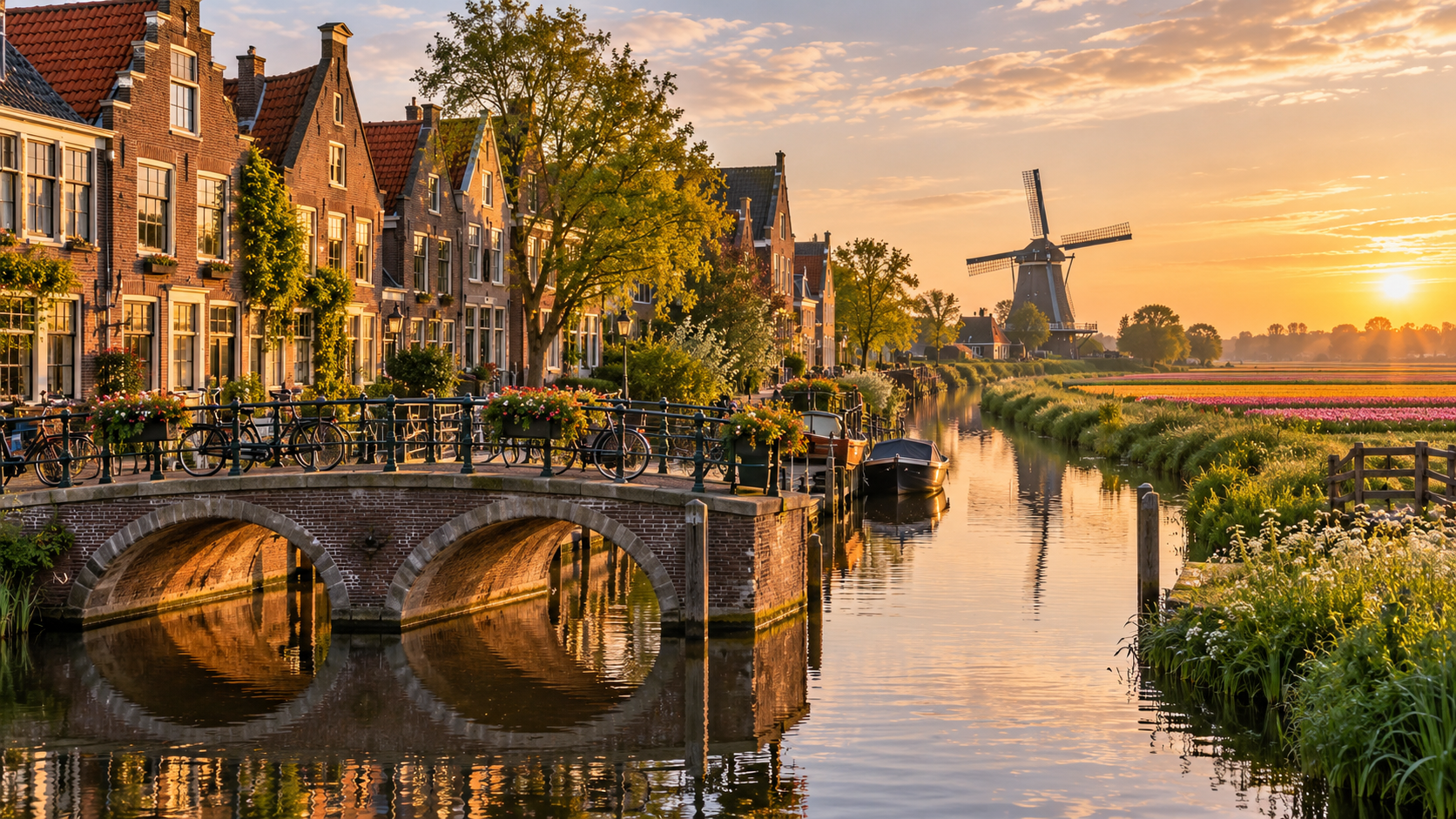
Say “Dutch country” to an American traveler and a few images usually appear right away: windmills, tulips, canals, wooden shoes, maybe a bicycle leaning against a narrow brick house.
None of that is wrong.
It is just a tiny slice of the Netherlands.
The country is compact, densely populated, heavily shaped by water, and much more varied than first-time visitors often expect. Amsterdam gets most of the attention abroad, but Dutch life is not simply Amsterdam repeated twenty times in smaller cities.
Rotterdam feels modern and architectural. Utrecht is compact and intimate. The Hague mixes government institutions with beaches. Maastricht can feel almost Belgian or French in mood. Friesland has its own language and identity. Zeeland looks toward the sea. Rural areas can be astonishingly quiet.
And then there is the Dutch relationship with space.
There is not much of it.
So nearly everything feels planned: roads, bike paths, housing, canals, farms, parks, flood defenses, and even where trees are planted.
That careful use of land is one of the easiest ways to understand the Netherlands.
First Things First: Holland Is Not the Whole Country
Americans often use “Holland” and “the Netherlands” as if they mean exactly the same thing.
Technically, they do not.
The Netherlands is the country. North Holland and South Holland are two of its twelve provinces.
Amsterdam is in North Holland. Rotterdam and The Hague are in South Holland. Because these provinces became economically and politically powerful, the name Holland became widely associated with the entire country abroad.
Dutch people will understand what you mean if you say Holland.
Still, the Netherlands is more accurate when talking about the country as a whole.
| Term | What It Means | Useful to Know |
|---|---|---|
| The Netherlands | The European country | The correct general name |
| Holland | North Holland and South Holland | Often informally used for the whole country |
| Dutch | People, language, or things from the Netherlands | Not related to Denmark |
| Amsterdam | Capital city | Not the seat of national government |
| The Hague | Government center | Home to parliament and many international institutions |
Why Is So Much of the Netherlands Flat?
The Netherlands is famously flat.
Really flat.
There are places where a highway overpass almost feels like a hill.
Large parts of the country consist of low-lying river deltas, coastal plains, polders, and reclaimed land. Water has shaped Dutch settlement for centuries.
The Dutch did not simply build beside water.
They reorganized it.
Dikes protect low areas. Pumps move water. Canals manage drainage. Polders are areas where water was removed and the land was enclosed for farming or settlement.
The name Netherlands literally points toward “low lands.”
And that is not poetic branding.
Some areas really do sit below sea level.
The Dutch Relationship With Water Is Serious Business
Windmills are often presented as cute symbols on postcards.
Historically, many had extremely practical jobs.
Some pumped water from low-lying land. Others ground grain, sawed timber, or supported industry.
Water management eventually moved far beyond windmills.
The Netherlands became internationally known for engineering systems designed around rivers, tides, storm surges, and flooding.
Major coastal defenses are part of everyday national infrastructure rather than tourist decoration.
In a place where water can become dangerous quickly, engineering becomes part of culture.
The Delta Works Show How Far That Engineering Went
After the catastrophic North Sea flood of 1953, the Netherlands developed an enormous system of dams, barriers, sluices, dikes, and storm-surge defenses known collectively as the Delta Works.
The goal was straightforward: reduce flood risk.
The engineering was anything but straightforward.
One of the best-known structures is the Oosterscheldekering, a huge movable storm-surge barrier in Zeeland.
It can remain open during normal conditions, helping preserve tidal ecosystems, and close when dangerous water levels threaten the coast.
For travelers interested in engineering, geography, or climate adaptation, this side of the Dutch country can be just as fascinating as Amsterdam’s canals.
Amsterdam Is Famous for a Reason
Amsterdam is one of those cities that looks almost suspiciously photogenic.
Canals curve between narrow townhouses. Bikes crowd bridges. Houseboats sit beside tree-lined streets. Small cafés occupy buildings that seem to lean toward each other.
The historic canal district developed largely during the Dutch Golden Age of the 17th century, when Amsterdam became a major center of trade and finance.
The city still carries that history in its architecture.
Look at the canal houses closely.
Many are unusually narrow because land and frontage were valuable. Some buildings even have hooks near the roof that were historically used to move goods or furniture through upper windows.
That makes sense once you see the staircases.
Some Dutch stairs appear designed for people with the balance of mountain goats.
Amsterdam Is Not an Open-Air Theme Park
Millions of visitors come for museums, architecture, nightlife, canals, and history.
But Amsterdam is also a functioning city where people work, take children to school, buy groceries, and become understandably irritated when someone stops in the middle of a bike lane to take a photo.
The basic rule is simple.
Do not stand in bike lanes.
Seriously.
A bell behind you is not necessarily a friendly greeting.
Rotterdam Looks Like a Different Country
Take a train from Amsterdam to Rotterdam and the visual shift is dramatic.
Rotterdam was heavily damaged during World War II, particularly during the bombing of May 1940.
Instead of rebuilding the old center exactly as it had been, the city embraced modern architecture.
Today, Rotterdam is full of experimental towers, bold apartment buildings, bridges, and large-scale urban design.
The Erasmus Bridge has become one of its main symbols.
The Cube Houses are another.
The Markthal combines apartments and a massive indoor food market beneath a colorful arched interior.
If Amsterdam feels historical and slightly romantic, Rotterdam often feels direct, modern, and energetic.
Rotterdam’s Port Is Part of the City’s Identity
Rotterdam developed around one of the world’s major ports.
The scale is hard to understand until you see the industrial landscape stretching toward the North Sea.
Containers, ships, logistics centers, petrochemical facilities, waterways, and huge terminals form an economic system far removed from tulip-field stereotypes.
The port helped establish the Netherlands as a major trade hub in Europe.
That commercial instinct has deep historical roots.
Utrecht Might Be the City Americans Underestimate Most
Utrecht has canals too.
But they behave differently.
Along parts of the historic center, wharf-level terraces sit below street level beside the water.
Restaurants occupy old storage spaces beneath the streets.
That gives Utrecht’s canals a character very different from Amsterdam.
The Dom Tower dominates the skyline and remains one of the city’s defining landmarks.
Utrecht also has a huge student population, so the city feels young despite its medieval core.
For some travelers, it becomes a favorite precisely because it has Amsterdam-like charm without feeling quite as overwhelmed by tourism.
The Hague Is Where Government Actually Happens
Here is one of those facts that confuses nearly everyone at first.
Amsterdam is the constitutional capital of the Netherlands.
But the Dutch government, parliament, ministries, and royal working institutions are centered in The Hague.
The city is also associated with international law and diplomacy.
Several major international courts and organizations are based there.
Architecturally, The Hague feels more formal than Amsterdam.
And then, just a short distance away, you reach Scheveningen and the North Sea.
Government meeting in the morning, beach walk in the afternoon.
Very Dutch.
Yes, Dutch People Really Bike That Much
Bicycles in the Netherlands are transportation.
Not primarily fitness equipment.
Not a weekend hobby.
Transportation.
People ride to work in office clothes. Parents carry children in cargo bikes. Teenagers bike to school. Older adults ride to shops. Rain does not automatically cancel the plan.
The reason goes beyond culture.
Infrastructure makes cycling practical.
Many cities have protected bike lanes, dedicated traffic lights, bike parking, and routes designed to separate cyclists from faster vehicle traffic.
The result is a system where biking can feel ordinary rather than adventurous.
Visitors Need to Learn the Bike Rules Quickly
- Do not walk in bike lanes.
- Look for cyclists before crossing, even when cars have stopped.
- Use hand signals when turning if you rent a bike.
- Do not suddenly stop in the middle of a cycle path.
- Lock rental bikes properly.
- Remember that local cyclists may travel much faster than tourists.
Amsterdam is probably not the ideal place to learn how to ride a bicycle from scratch.
A quieter town is much kinder to your dignity.
Dutch Cities Feel Compact for a Reason
Urban areas in the Netherlands tend to be dense by American standards.
Daily life is often organized around short distances.
Shops, schools, parks, transit stops, housing, cafés, and supermarkets frequently sit close together.
This changes how cities feel.
You may walk ten minutes and pass more daily services than you would encounter during a long drive through an American suburb.
Public transportation connects the spaces between cities efficiently as well.
Rail travel is especially important.
Amsterdam, Rotterdam, The Hague, Utrecht, Leiden, Delft, Haarlem, and other cities are close enough that travelers do not need domestic flights between them.
The idea would be almost comical.
Train Travel Makes Exploring the Netherlands Easy
For an American visitor, one of the biggest surprises can be how casually people move between cities.
A destination that might feel like a separate trip in the United States can function like an afternoon outing here.
Amsterdam to Utrecht is quick.
The Hague and Rotterdam are close.
Delft fits naturally between larger cities.
Leiden makes an easy day trip.
You can create a multi-city itinerary without repacking your suitcase every morning.
Delft Looks Almost Too Dutch
Delft has canals, historic houses, church towers, quiet courtyards, and ties to painter Johannes Vermeer.
It is also famous for Delftware, the blue-and-white pottery often associated with the Netherlands.
The old center is compact enough to explore slowly.
That matters.
The Netherlands rewards walking without a checklist.
A small bridge, hidden courtyard, bakery window, or old doorway can be more memorable than another official attraction.
Haarlem Is an Easy Alternative to Amsterdam Crowds
Haarlem lies west of Amsterdam and has a handsome historic center built around the Grote Markt.
Churches, museums, restaurants, and traditional streets make it an easy day trip.
The city also sits relatively close to North Sea beaches and the famous flower-growing areas.
If Amsterdam feels too busy, Haarlem can work as a calmer base while keeping you within easy reach of the capital.
Leiden Has Canals, History and a University Energy
Leiden is one of the country’s major historic university cities.
The university dates to the 16th century.
The city combines canals, museums, old academic buildings, courtyards, and a compact historic center.
Leiden is also associated with the Pilgrims who later sailed to North America aboard the Mayflower.
Several members of that community lived here before their Atlantic journey.
For American visitors, that creates an unexpected connection between Dutch and early colonial American history.
Maastricht Feels Different From the Randstad
Go south to Maastricht and the visual language changes.
The surrounding province of Limburg has rolling terrain that already feels unusual after the western Netherlands.
Buildings, food, landscape, and accents reflect the city’s position near Belgium and Germany.
Maastricht has Roman origins, medieval streets, major churches, caves, cafés, and a more southern European atmosphere than many visitors expect.
It is also associated with the Maastricht Treaty, signed in 1992, which played a key role in the development of the European Union.
Groningen Brings Northern Energy
Groningen is far from Amsterdam by Dutch standards.
By American standards, that statement may produce a laugh.
The northern city has a large student population and an especially strong cycling culture.
Its historic center mixes traditional architecture with newer cultural buildings.
The surrounding province becomes much quieter once you leave the city.
Northern Netherlands feels more spacious, especially compared with the densely populated western region.
Friesland Has Its Own Language
The province of Friesland, or Fryslân, has a distinct identity.
West Frisian is officially recognized alongside Dutch in the province.
You will see bilingual place names and signs in some areas.
Water sports are central to local culture because lakes and waterways cover much of the landscape.
Skating also has a special place in regional identity.
The famous Elfstedentocht is a long-distance skating event connecting eleven Frisian cities when natural ice conditions are safe enough.
The catch?
Those conditions are rare.
That scarcity has made the event almost mythical.
Windmills Were Working Machines
Few objects are more strongly associated with the Netherlands.
But seeing a historic windmill in person changes how you think about it.
These are huge machines.
Some drained water. Some processed grain. Some powered sawmills or other industrial work.
Two famous places offer very different windmill experiences.
| Place | What You See | Best For |
|---|---|---|
| Kinderdijk | Historic windmills in a water-management landscape | History and photography |
| Zaanse Schans | Windmills, historic buildings, craft demonstrations | Easy trip from Amsterdam |
| Keukenhof area | Flower fields and seasonal gardens nearby | Spring travel |
| Flevoland | Modern reclaimed landscapes | Understanding Dutch land engineering |
Kinderdijk Explains the Country Better Than a Souvenir Shop
Kinderdijk has a concentration of historic windmills set beside canals and low fields.
The landscape is beautiful, but the real story is water control.
The mills formed part of a larger drainage system that helped keep low-lying land usable.
This is the Dutch country stereotype with the engineering left in.
And that makes it much more interesting.
Tulips Are Dutch, but Not Originally Dutch
Tulips became deeply associated with the Netherlands after arriving from the Ottoman world centuries ago.
They became fashionable during the 17th century, and the famous tulip speculation episode later entered economic history.
Today, Dutch horticulture remains a major industry.
Spring flower fields can be spectacular.
But timing matters.
Flowers do not care about your prepaid hotel reservation.
Blooming conditions change each year depending on weather.
Keukenhof Is Seasonal, Not a Year-Round Flower Park
Keukenhof opens for a limited spring season.
Its displays feature huge numbers of flowering bulbs, including tulips, hyacinths, and daffodils.
The surrounding region also contains commercial flower fields.
There is an important etiquette issue here.
Do not walk into private fields simply because you saw someone doing it on social media.
Those flowers are crops.
A nice photo does not magically cancel private property.
What Do Dutch People Actually Eat?
Dutch food has never had the international fame of Italian, Japanese, or Mexican cuisine.
That does not mean there is nothing interesting to eat.
Traditional food often reflects a practical northern climate: potatoes, vegetables, dairy, bread, fish, meat, and filling stews.
But modern Dutch cities are extremely international.
Indonesian, Surinamese, Turkish, Moroccan, Caribbean, and other influences are part of everyday food culture.
That is especially obvious in Amsterdam, Rotterdam, and The Hague.
Indonesian Food Has a Deep Dutch Connection
Indonesia was once part of the Dutch colonial empire.
That history was violent and deeply unequal, but it also created lasting cultural links.
Indonesian dishes became embedded in Dutch dining culture.
Rijsttafel, literally “rice table,” developed during the colonial period and presents numerous small dishes around rice.
You will find Indonesian restaurants throughout the country.
For many foreign visitors, that becomes one of the unexpected food highlights of the trip.
Surinamese Food Is Another Part of Modern Dutch Life
Suriname, on the northeastern coast of South America, also has a historical colonial connection with the Netherlands.
Migration has made Surinamese food easy to find in larger Dutch cities.
The cuisine itself reflects Suriname’s remarkable cultural diversity, with influences from South Asia, Indonesia, Africa, China, Europe, and Indigenous communities.
Eating in the Netherlands makes more sense once you stop expecting every meal to look traditionally northern European.
Still, Try the Classic Snacks
- Stroopwafels: thin waffle cookies with syrup filling.
- Bitterballen: crispy fried snacks filled with thick meat ragout.
- Poffertjes: small fluffy pancakes usually served with powdered sugar and butter.
- Haring: raw or lightly cured herring served in traditional styles.
- Kibbeling: battered and fried pieces of fish.
- Patat: thick fries commonly served with various sauces.
- Oliebollen: fried dough treats strongly associated with New Year’s season.
And yes, Dutch people put mayonnaise on fries.
Try it before judging.
Cheese Is More Than Gouda
Gouda is both a city and the name associated with one of the world’s best-known Dutch cheeses.
Edam has a similar double identity.
Dutch cheese varies enormously by age.
Young cheese is soft and mild.
Older cheese becomes harder, saltier, and more intense.
Aged Gouda can taste completely different from the mass-market slices many Americans know.
Cheese shops often allow tastings, which is dangerous if you planned to “just look.”
Dutch Directness Can Surprise Americans
Dutch communication is often described as direct.
Someone may tell you plainly that an idea does not make sense.
They may skip the long layer of softening language an American office worker might add first.
This is not automatically intended as rude.
Clarity can be valued over elaborate politeness.
That difference can be refreshing once you understand it.
Or slightly shocking on Monday morning.
Privacy and Independence Matter Too
Dutch society often places strong value on personal independence and clear boundaries.
People can be friendly without immediately becoming deeply personal.
Social plans may be scheduled well in advance.
Showing up unexpectedly is not always treated as spontaneous charm.
Calendars matter.
Even casual coffee can have a time slot.
“Gezellig” Explains Something Google Translate Cannot
The Dutch word gezellig is often translated as cozy.
That is close, but not complete.
A candlelit café can be gezellig.
Dinner with friends can be gezellig.
A small street can feel gezellig.
A relaxed evening at home can be gezellig.
The word describes a kind of warm, pleasant social atmosphere.
It is less about interior decoration than about how a place or moment feels.
Once you hear it enough, you start understanding it without translating it.
King’s Day Turns the Country Orange
King’s Day is one of the biggest annual celebrations in the Netherlands.
People wear orange, cities fill with outdoor parties, and streets become crowded with markets, music, and events.
The orange comes from the House of Orange-Nassau, the Dutch royal family.
Amsterdam gets especially intense.
If you love crowds and street parties, it can be unforgettable.
If you hate crowds, choose another day.
There is no secret quiet version of central Amsterdam during King’s Day.
Sinterklaas Is Not Simply Dutch Christmas
Sinterklaas arrives during the weeks before December 5, when gift-giving traditions center on Saint Nicholas.
Children leave shoes for small gifts and sweets.
Chocolate letters and spiced cookies appear everywhere.
The celebration has its own songs, customs, television events, and family traditions.
It exists alongside Christmas rather than replacing it.
Some aspects of older Sinterklaas traditions have also been the subject of significant social debate and change in recent years.
The Dutch Golden Age Was Brilliant and Complicated
The 17th century was a period of extraordinary Dutch economic and cultural power.
Amsterdam became a major financial and trading center.
Artists such as Rembrandt and Vermeer produced work that now fills famous museums.
Science, mapmaking, publishing, and commerce expanded.
But there is a darker side.
Dutch wealth was tied partly to colonial expansion, warfare, forced labor, and slavery.
The Dutch East India Company and Dutch West India Company operated across global trade networks that often relied on violence and exploitation.
Modern museums increasingly present both sides of that story.
That fuller picture makes the period more interesting, not less.
Museums Are a Big Part of Dutch Culture
The Rijksmuseum in Amsterdam covers Dutch art and history.
The Van Gogh Museum holds the world’s largest collection of works by Vincent van Gogh.
The Mauritshuis in The Hague includes major paintings by Vermeer and other Dutch masters.
The Anne Frank House addresses the Holocaust through one family’s experience during the Nazi occupation.
Rotterdam has strong architecture and contemporary culture institutions.
Leiden has major museums connected with science, archaeology, and ethnology.
Even smaller cities often have surprisingly serious museums.
World War II Is Still Visible in Dutch Memory
Germany occupied the Netherlands from 1940 until 1945.
Dutch Jewish communities suffered devastating persecution and deportation during the Holocaust.
Resistance networks operated across the country, while other citizens collaborated with the occupying regime.
The final winter of the war brought severe hunger to parts of the western Netherlands.
Memorials, museums, cemeteries, and annual remembrance ceremonies keep this history visible.
It is impossible to understand modern Dutch identity entirely through cheerful travel imagery.
When Is the Best Time to Visit?
There is no single perfect month.
Spring attracts flower lovers.
Summer brings long evenings and busy outdoor terraces.
Early fall can be pleasant and less intense.
Winter is darker, wetter, and quieter but can work beautifully for museums, cafés, and city trips.
Rain is possible in any season.
Wind is also part of the package.
Pack accordingly.
A Simple First Trip Through the Dutch Country
If you have one week, resist the urge to visit eight cities.
The distances are short, but constant movement still gets tiring.
A balanced trip could look like this:
- Spend three days in Amsterdam for museums, canals, neighborhoods, and history.
- Take a day trip to Haarlem, Leiden, or Utrecht.
- Stay two nights in Rotterdam and visit Delft or The Hague.
- Use one day for Kinderdijk, Zaanse Schans, or another landscape-focused trip.
- Add Keukenhof only during its spring opening season.
With ten to fourteen days, head farther north, south, or east.
Maastricht, Groningen, Friesland, Zeeland, and the national parks show a very different country from the Amsterdam region.
FAQ About Dutch Country
What country is Dutch?
Dutch refers primarily to the Netherlands, its people, and its main language. Dutch is also spoken in Belgium, particularly in Flanders, and in several Caribbean parts of the Kingdom of the Netherlands.
Is Holland the same as the Netherlands?
Not exactly. Holland refers specifically to the provinces of North Holland and South Holland. The Netherlands is the name of the entire country.
Why is the Netherlands called Dutch in English?
The English word Dutch developed historically from Germanic language terms that once referred more broadly to continental Germanic-speaking peoples. Over time, English usage narrowed the word mainly to people and language from the Netherlands.
What is the Netherlands most famous for?
The country is known for canals, cycling, windmills, tulips, water engineering, historic cities, Dutch painting, cheese, international trade, and a highly developed transportation network.
What are the best Dutch cities to visit besides Amsterdam?
Utrecht, Rotterdam, The Hague, Delft, Leiden, Haarlem, Maastricht, and Groningen are all strong choices. Each has a noticeably different atmosphere.
Do people speak English in the Netherlands?
English is widely spoken, especially in cities, tourist areas, universities, and international workplaces. Travelers can usually manage easily, though learning a few Dutch phrases is still appreciated.
How many days do you need in the Netherlands?
Seven days is enough for Amsterdam plus several nearby cities. Ten to fourteen days allows a slower trip that includes different regions, landscapes, and smaller cities.
The Netherlands Makes More Sense When You Look Beyond the Clichés
The stereotypes are not fake.
There really are windmills.
There really are tulip fields.
There are more bicycles than most visitors know what to do with.
Cheese shops appear everywhere.
Canals can make an ordinary street look like a postcard.
But the interesting part begins after those first impressions.
The Netherlands is a country built around managing limitations.
There is limited land, so cities became compact.
Water creates constant pressure, so engineering became part of national survival.
Dense cities make short-distance mobility important, so bicycles and trains became practical parts of everyday life.
Centuries of global trade brought wealth, cultural exchange, migration, and also colonial violence that modern Dutch society is still examining.
That history explains why Rotterdam can feel global, why Indonesian food feels normal rather than exotic, and why museums increasingly tell more complicated stories about the Golden Age.
The country also changes surprisingly fast when you travel.
Amsterdam’s canals give way to Rotterdam’s towers.
The government buildings of The Hague lead toward a sandy North Sea beach.
Utrecht puts restaurants below street level beside medieval canals.
Maastricht feels almost southern European after a few days in the west.
Friesland adds another language.
Zeeland makes the sea impossible to ignore.
Flevoland reminds you that humans literally created large stretches of the landscape by reclaiming land from water.
And somewhere between all these places, a person on a bicycle will probably pass you while carrying two children, groceries, and somehow an umbrella.
That may be the most Dutch scene of all.
For American travelers, the scale can be especially refreshing.
You do not need to fly between major destinations.
You do not need a rental car for every outing.
A train, tram, bicycle, or pair of comfortable shoes can take you remarkably far.
And that makes the country easy to experience slowly.
Have coffee beside a canal.
Walk through an old neighborhood without trying to photograph every house.
Try aged cheese instead of only familiar supermarket Gouda.
Take a train to a city you had never heard of before planning the trip.
Watch how people actually use bicycles rather than treating them as a tourist attraction.
Visit a windmill and learn what job it originally performed.
Stand beside one of the enormous water barriers and realize that the cute windmill story eventually became advanced coastal engineering.
This is what makes the dutch country interesting.
It is not simply picturesque.
It is practical.
It is historical, but comfortable with modern design.
It can be direct but also deeply gezellig.
It is heavily urbanized yet still filled with farms, dunes, wetlands, beaches, forests, and open skies.
And for such a small country on the map, it gives you an awful lot to talk about once you get home.

Leave a Reply