
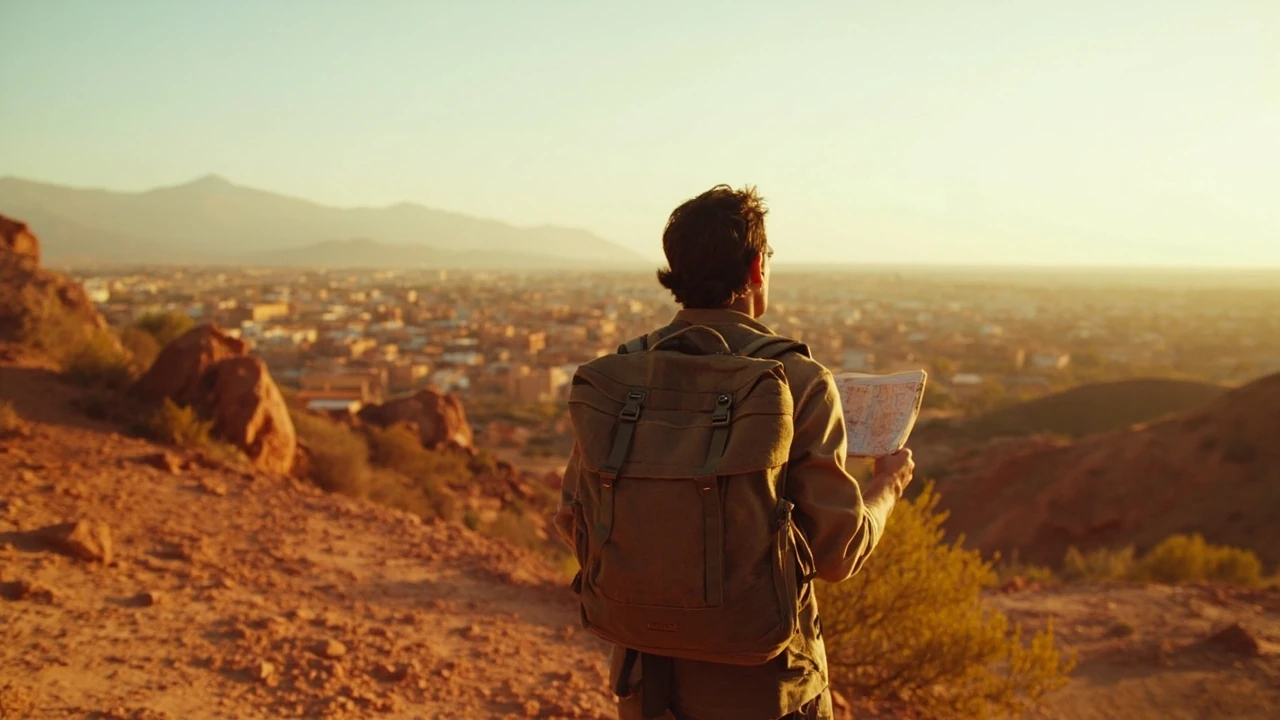
Is Morocco in the Middle East?
The short answer is no under the most common geographical definition: Morocco is in northwestern Africa, not in the Middle East. The confusion is understandable because Morocco is an Arab country, its official language is Arabic, and some broad definitions of the Middle East include North Africa. In other words, Morocco shares important cultural and historical ties with the Middle East, but its physical location is on the African side of the Mediterranean.
This distinction matters when sorting out maps, travel guides, regional terminology, and airline or tour itineraries. It can also affect how travelers describe their trip without turning a geography question into a debate over identity. A useful answer separates four things: where Morocco is, what “Middle East” means, where Morocco fits culturally, and how travel businesses group destinations for practical reasons.
The geographic answer remains the clearest: Morocco lies across the Strait of Gibraltar from southern Europe and forms part of the Maghreb, the region of North Africa that includes Morocco, Algeria, Tunisia, Libya, and Mauritania. It borders Algeria to the east, Western Sahara to the south, and the Atlantic Ocean to the west and north. The Mediterranean lies to the north. Those physical relationships place Morocco in Africa.
Still, the answer is not always as simple as pointing to a map. Some older or broader definitions of the Middle East extend into North Africa, while others exclude Morocco. Terminology such as “Middle East and North Africa,” commonly shortened to MENA, deliberately combines two geographic regions. The result is that a destination can be African geographically and included in a Middle Eastern or MENA travel framework without becoming Middle Eastern geographically.
The geographic answer: Morocco is in northwest Africa
Morocco occupies the northwestern corner of Africa. Its northern coast faces Spain across the Strait of Gibraltar, and the country extends south into the Maghreb and the Sahara. The Atlas Mountains run through much of the country, separating coastal and northern areas from drier regions farther south and east. Cities such as Marrakesh, Fez, Essaouira, Tangier, and Casablanca occupy different geographic settings, but all remain in North Africa.
Three coordinate systems make the location especially clear:
- Continental: Morocco is part of Africa, not Asia.
- Regional: It belongs to the Maghreb and wider North Africa.
- Local: Its coast faces the Mediterranean, while its Atlantic coastline runs along the northwest corner of the continent.
The distinction between continental and regional labels also explains why coastlines can sometimes make a place feel deceptively connected to Europe. Morocco faces Spain and sits at the western entrance to the Mediterranean, yet proximity across water does not move a country onto another continent. The Strait of Gibraltar is a narrow body of water, but it remains a geographic boundary.
For map-reading purposes, the safest classification is “Morocco, northwest Africa.” Calling it a Mediterranean country also makes sense because a substantial part of the country fronts the Mediterranean. “North African” is broader and more regionally precise. Calling it a Middle Eastern country introduces an ambiguity that needs explanation because regional definitions are not uniform.
| Question | Best answer | Why |
|---|---|---|
| On which continent is Morocco? | Africa | Morocco is part of the African continent and belongs to the Maghreb. |
| Is Morocco in North Africa? | Yes | North Africa is its standard geographic and regional classification. |
| Is Morocco on the Mediterranean? | Yes | Its northern coastline meets the Mediterranean Sea. |
| Is Morocco geographically in the Middle East? | Generally no | Most modern definitions treat the Middle East as a region centered on western Asia, with some definitional exceptions. |
| Can Morocco appear in Middle East or MENA travel material? | Yes | Travel publishers and tour operators often group North Africa with the Middle East for cultural or itinerary purposes. |
This table separates the uncontested physical facts from the more flexible language used to group countries. A country can be included in a commercial or cultural category without changing its continental location.
Why definitions produce different answers
The phrase “Middle East” is commonly used as though it has one permanent boundary. In practice, its limits vary by source, period, and subject. A publisher organizing an atlas may define it one way, while a historian focusing on empires or language may use another. This is why online answers sometimes sound contradictory even when each is trying to describe a different kind of region.
One common historical and regional approach includes countries in western Asia and, depending on the definition, Egypt and the rest of North Africa. Another approach focuses more tightly on the lands east of the Mediterranean and excludes North Africa. The supplied regional population overview illustrates the first type of variation by describing the Middle East as spanning western parts of Asia and northern parts of Africa and by including North African countries in some historical and demographic comparisons.
That variation means “Is Morocco in the Middle East?” has no perfectly useful one-word answer if the question does not specify the context. A short answer can identify the conventional geographic classification, while a fuller answer explains why a source may group it differently. This is especially relevant for travel content, which may organize trips by air routes, tour markets, regional tours, or themes such as Arab culture and Islamic architecture.
The difference between a geographic region and a travel category is important. Geographers ask where a place is and which broader physical or cultural region contains it. Publishers and tour operators decide how to arrange destinations so readers can find practical information. A “Middle East vacation” package might include Morocco, Jordan, and Oman because the operator wants to sell an itinerary across North Africa and western Asia. That package title does not redraw the boundaries of the Middle East.
- Geographic definition: A territorial system used to describe where countries or territories are located.
- Cultural grouping: A broad category based on language, religion, history, food, or customs.
- Historical definition: A term applied to an empire, trade network, or political sphere that may no longer match modern borders.
- Commercial category: A publishing or tour-operator grouping designed to organize itineraries.
None of these categories is automatically wrong. The error comes from presenting a cultural or commercial grouping as if it were the only correct continental location. Morocco can be discussed within a broader Middle Eastern context without being moved from Africa onto the map.
Morocco’s place in the Arab world and North Africa
Morocco is the westernmost country in the Arab world, a term used for countries and communities where Arabic is an official or central language and Arabic culture has deep historical influence. Morocco’s official name is the Kingdom of Morocco, Arabic is its official language, and Amazigh is also widely recognized and used. These facts help explain why some travelers or readers immediately place it in a Middle Eastern frame.
The country’s cultural position is more precisely described as North African and Amazigh-Arab. Its Amazigh heritage predates Arab rule and extends across North Africa. Arabization, Islamic history, migration, trade, and contact with Mediterranean societies have all influenced the country, but they have not erased that distinct North African foundation.
Historically, Morocco has served as a meeting point between Africa, Europe, and the Middle East. Its ports carried trade across the Mediterranean and along the Atlantic. Dynasties and religious scholars connected Morocco to the wider Islamic world, while its position on the Strait of Gibraltar gave it strategic importance in relations with Europe. This layered history makes “Arab” accurate, but “only Middle Eastern” incomplete.
The term Maghreb offers a more precise regional frame. Derived from the Arabic word for west, it refers to the northwestern part of Africa and is especially associated with Morocco, Algeria, Tunisia, Libya, and Mauritania. Maghrebi cultures share Arabic and Amazigh traditions while also reflecting Amazigh, sub-Saharan African, Iberian, Mediterranean, and other influences. Morocco should not be reduced to a cultural extension of the Middle East any more than it should be treated as culturally disconnected from it.
| Label | How well it fits Morocco | Useful nuance |
|---|---|---|
| Africa | Exact | The only continent on which Morocco is located. |
| North Africa | Exact | Its standard broad geographic region. |
| Maghreb | Highly precise | The best regional term for Morocco’s northwestern African setting and cultural connections. |
| Arab world | Accurate | Arabic is official, and the country has deep cultural and historical ties to the Arab world. |
| Middle East | Definition-dependent | It may appear in broad cultural, historical, or travel classifications, but it is not the standard geographic answer. |
| Mediterranean | Partly useful | Morocco has a Mediterranean coast, but the label describes a sea connection rather than its continental location. |
For a visitor, the labels are not interchangeable in every situation. “North African itinerary” usually suggests Morocco’s coastal cities, imperial cities, mountain landscapes, and Saharan routes. “Middle East vacation” may group Morocco with destinations farther east such as Jordan or Oman. Either label can be useful, but a careful travel plan should clarify which places are included.
What the distinction means for travelers
Most travelers do not need to settle a geopolitical definition before booking a flight. The distinction becomes useful when comparing destinations, building an itinerary, or understanding why a guidebook places Morocco in a particular chapter. It can also prevent an expectation mismatch: Morocco shares some traditions with countries farther east, but its landscapes, languages, cuisine, and local histories reflect North Africa.
Morocco combines several travel environments in one country. A trip can include Atlantic fishing towns and beaches, Mediterranean ports, medinas in imperial cities, High Atlas mountain roads, and desert landscapes. Cultural connections with the Middle East may be visible in architecture, religious traditions, and Arabic-language materials, yet the journey still has a strong Amazigh, Maghrebi, and African character.
When comparing Morocco with another destination, start with the experience rather than the regional label. A traveler looking for famous ancient monuments, for example, may find a different emphasis in Greece than in Morocco. A traveler interested in modern urban design and food culture may find an especially close comparison with South Korea. South Korea has far more than neon Seoul, a useful reminder that regional labels cannot tell a visitor whether a country suits their interests.
It is also useful to compare Morocco with another destination that appears in the same travel guide. Panama, for instance, is geographically in Central America, although English is widely used and its canal links the Caribbean with the Pacific. Panama is much more than the canal explores the wider country. As with Morocco, the best description depends on whether the issue is physical location, language, history, or the purpose of the itinerary.
A practical travel-planning list can look like this:
- Place: Note whether the itinerary labels the destination as North African, Arab, Mediterranean, or part of a broader Middle Eastern circuit.
- Culture: Research Moroccan Amazigh, Arab, and Maghrebi influences rather than assuming a trip is culturally identical to Jordan, Egypt, or the Gulf.
- Landscape: Consider which environments interest you: cities, mountains, coast, desert, or a combination.
- Connections: Look at transport links, regional flight routes, and nearby stops rather than relying on a destination label.
- Current rules: Confirm entry, health, and other requirements with official government and health sources before travel.
The best destination guide therefore answers practical questions. Does the country match the scenery, food, history, and pace you want? Are the proposed stops close enough to travel efficiently? Are any local health or entry requirements relevant to your circumstances? Regional geography helps organize the answer, but it does not replace these checks.
Why the Middle East and MENA labels are often used for Morocco
MENA is the label most likely to create the appearance of a contradiction. The abbreviation combines “Middle East” and “North Africa,” so a country can be included in MENA because it is North African without being classified as geographically Middle Eastern. MENA is used by governments, businesses, organizations, and media for different purposes, and the boundaries are not always identical from one institution to another.
The term has practical value in several contexts. It can connect markets, energy systems, migration patterns, security discussions, and cultural programming across a wide area. It may also simplify tourism marketing by presenting countries that are geographically distant but connected by air routes, heritage themes, or shared visitor interests. The label tells readers that these destinations are being discussed together; it does not always make a precise claim about continental boundaries.
Broader “Middle East” travel categories can also reflect itinerary logic. A tour operator might pair Morocco with Turkey, Jordan, and Oman because the combined route appeals to travelers interested in architecture, food, deserts, and historic cities. Another publisher might place Morocco in a North Africa section because its destination index is organized around individual regions. In both cases, the reader should inspect the actual contents rather than infer the physical location from the heading.
Language can also blur categories. Arabic-speaking Morocco sits within the Arab world, which reaches from Morocco across North Africa into the Middle East and beyond. Calling Morocco part of the Arab world is not the same as calling it part of the Middle East. The first is cultural and linguistic; the second is regional and, under standard usage, geographic.
| Term | Primary purpose | Does it place Morocco in the Middle East? |
|---|---|---|
| Middle East | Regional geography, politics, history, or a travel category | Not under most standard geographic definitions; possible in some broader ones. |
| MENA | A combined framework covering the Middle East and North Africa | Yes, as part of the North Africa portion, not because it is geographically in the Middle East. |
| Arab world | Language, culture, and shared history | Not as a geographic test; Morocco belongs to the Arab world. |
| Maghreb | The western region of North Africa | No. This is the most precise regional label for Morocco. |
| Africa | Continental classification | Morocco is in Africa, with no ambiguity. |
When someone uses MENA, there is rarely any need to challenge the wording. The label already says that North Africa is included. The possible confusion begins when MENA is paraphrased as “the Middle East” and the North African component disappears.
Common misconceptions and confusing statements
Several statements appear often in conversations about Morocco and the Middle East. Some are simply imprecise, while others come from legitimate alternative definitions. Separating them helps readers understand why maps, guidebooks, and people may use different labels.
The first misconception is that being on the Mediterranean makes a country Middle Eastern. The Mediterranean is shared by Europe, Africa, and Asia, so it cannot serve as a single continental boundary. Egypt and Morocco have Mediterranean coasts and are African. Turkey, Lebanon, and Israel have Mediterranean coasts and are generally considered part of the Middle East. Coastal position therefore cannot settle the classification.
The second is that Arabic-speaking countries are necessarily part of the Middle East. Arabic is official across North Africa, including Morocco, Algeria, Tunisia, Libya, Sudan, and Mauritania. The language connects these places culturally without making their geography identical. Morocco is a good example of how the Arab world and the Middle East overlap without being synonymous.
The third misconception is that a country called part of the Middle East in a tour brochure must be geographically located there. Brochures are sales and itinerary documents. Their groupings may reflect route design, air connections, market demand, historical themes, or editorial convenience. A geography guide and a tour catalog answer different questions.
Other statements need more careful handling:
- “Morocco is part of the Middle East because of its Arab culture.” This confuses cultural identity with geographic location.
- “Morocco is not connected to the Middle East.” This is too broad. Trade, scholarship, Islamic history, language, and political relationships have long connected the two regions.
- “Morocco is part of North Africa, so it has no Middle Eastern influence.” The coast, trade routes, language, religion, and artistic traditions complicate any simple boundary.
- “Any country in MENA is in the Middle East.” MENA explicitly combines two regions, so this conclusion does not follow.
The most accurate answer can be concise: Morocco is geographically in northwestern Africa, culturally part of the Arab world, and often included in broader Middle Eastern or MENA travel discussions. Each clause has a different purpose and should not be collapsed into one disputed label.
How to describe Morocco accurately in writing and conversation
Accuracy does not require avoiding “Middle East” whenever it might appear in a source. It requires matching the label to the context. In a geography lesson, the answer should be that Morocco is in North Africa. In a discussion of the Arab world, Morocco is included because of its language, culture, and history. In a travel market that calls a combined set of itineraries MENA, Morocco belongs to the North African portion.
For a general description, “Morocco is a North African country in the Maghreb” is precise and adds more information than simply calling it part of the Middle East. “Morocco is an Arab country on the Mediterranean and Atlantic coasts of northwestern Africa” highlights additional connections. “Morocco is included in some broad Middle East travel groupings” is accurate when explaining a specific source rather than making a universal geographic claim.
It also helps to distinguish the answer from a value judgment. Saying that Morocco is “the Middle Eastern part of Africa” or “the European part of Africa” adds an unsupported cultural or political judgment. Geography can identify the continent, and regional terminology can identify cultural or historical relationships. Neither requires a competition between identities.
For readers planning a trip, the practical conclusion is simple. Do not select Morocco merely because a publisher places it beside Middle Eastern destinations, and do not rule it out for the same reason. Compare individual places, experiences, travel times, and current official requirements. Regional organization is a convenience; the itinerary itself should determine whether the destination fits.
A final check before booking can include these questions:
- Does the source use “Middle East” geographically, culturally, historically, or commercially?
- Does it mean the Middle East alone, or the combined MENA region?
- Does the itinerary emphasize Morocco’s North African heritage, its Arab connections, or both?
- Are the included cities and landscapes relevant to the traveler’s interests?
- Have current entry, health, and local requirements been checked with official sources?
This method answers the original question without pretending that regional boundaries are identical in every context. It also gives travelers a more accurate basis for comparison than a single label can provide.
Frequently asked questions
Is Morocco officially in the Middle East?
Morocco is officially and geographically classified as a country in northwestern Africa, within the Maghreb. It is not generally included in the Middle East under standard modern geographic definitions. Some broad historical or travel classifications place North Africa inside a wider Middle Eastern framework, so the label can vary by source, but North Africa is the clearest answer.
Is Morocco in North Africa or the Middle East?
Morocco is in North Africa. It belongs to the Maghreb, the western part of the Arab world, and has cultural and historical connections with the Middle East. Those connections explain the confusion without changing its continental location.
Is Morocco part of MENA?
Yes. MENA stands for the Middle East and North Africa, and Morocco is included through its North African position. MENA is a combined organizational term, so membership does not mean that every member is geographically part of the Middle East.
Why do some travel websites call Morocco part of the Middle East?
Some publishers use “Middle East” broadly for travel, cultural, or historical content that also includes North Africa. Others place it in a Middle Eastern tour because of airline routes, regional itineraries, architecture, cuisine, or shared Arab and Islamic heritage. The grouping may be commercially useful, but it is not a precise statement about Morocco’s continental location.
Does Morocco have a Middle Eastern culture?
Morocco has Arab, Amazigh, Maghrebi, sub-Saharan African, Mediterranean, and European influences. Calling it Middle Eastern is incomplete because it overlooks the country’s distinctive North African and Amazigh foundations. Arab culture is important, but it is one part of a more complex cultural history.
Is Morocco in Africa or the Arab world?
Both descriptions can be true because they describe different categories. Morocco is physically in Africa and is part of the Arab world because Arabic is its official language and its history, culture, and institutions have long been connected to the wider Arab world. One classification does not cancel the other.
Is Morocco considered a Mediterranean country?
Yes. Morocco has a long coastline on the Mediterranean Sea in the north as well as an Atlantic coast to the west. Mediterranean describes a significant geographic and maritime connection, but it does not make Morocco geographically Middle Eastern.
Which term should I use for Morocco in a travel article?
Use “Morocco, a North African country in the Maghreb” for maximum geographic precision. You can add that it is part of the Arab world and has Mediterranean and Atlantic coastlines. Mention broader Middle Eastern or MENA classifications only when discussing a particular source, itinerary, or historical definition.
Does this regional label change entry requirements for U.S. travelers?
The regional label itself does not determine entry requirements. Travelers should verify current information with official government and health authorities based on their nationality, itinerary, and circumstances. Requirements can change, so a reliable current check should take priority over travel articles or itinerary groupings.
What is the simplest accurate answer to the question?
Morocco is in northwestern Africa, not geographically in the Middle East under most modern definitions. It belongs to the Maghreb and the Arab world, and it may appear in broad Middle Eastern or MENA travel material because those terms can combine North Africa with western Asia.

Leave a Reply