
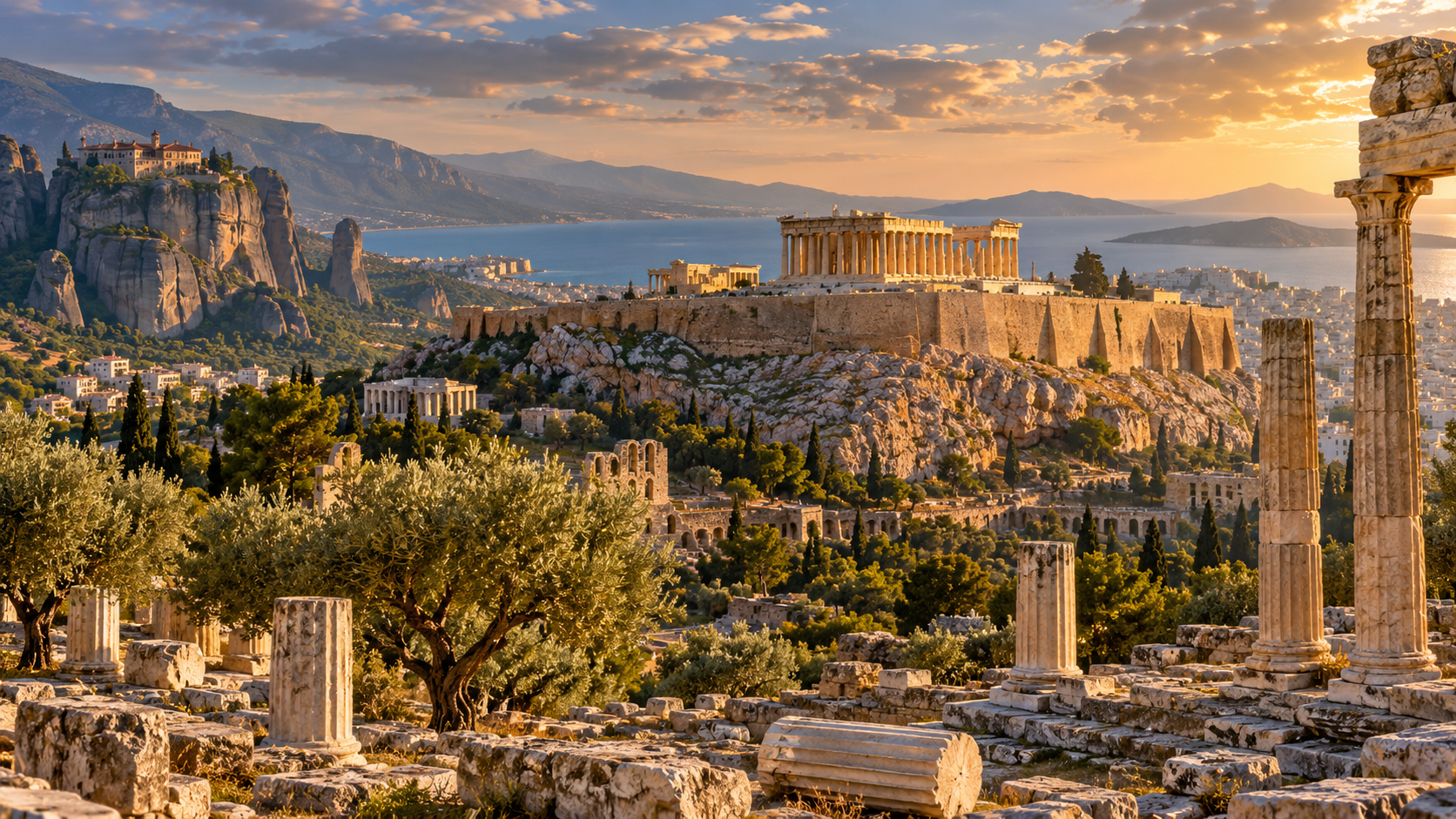
For many Americans, Greece history starts with marble columns, philosophers in robes, and stories about Zeus.
That is understandable. Ancient Greece left an enormous mark on Western culture. Democracy, theater, philosophy, architecture, mathematics, and political thought all carry Greek fingerprints.
But Greece did not freeze after the Parthenon was built.
The country moved through Roman rule, the Byzantine Empire, centuries of Ottoman control, a difficult war for independence, monarchy, dictatorship, occupation during World War II, civil conflict, and eventually a modern democratic republic.
In other words, Greece has layers.
Lots of them.
You can see those layers in one afternoon in Athens. A classical temple stands near a Byzantine church. Roman ruins sit beside a modern metro station. Ottoman traces appear around old neighborhoods, while apartment blocks from the 20th century fill the hills beyond.
That mix is what makes Greek history feel unusually close.
Before Classical Greece Came the Bronze Age
The story begins long before Socrates or Alexander the Great.
During the Bronze Age, powerful cultures developed in and around the Aegean Sea.
Two are especially important: the Minoans and the Mycenaeans.
| Civilization | Approximate Period | Main Area | Known For |
|---|---|---|---|
| Minoan | c. 3000-1100 BCE | Crete | Palaces, maritime trade, art |
| Mycenaean | c. 1600-1100 BCE | Mainland Greece | Fortified centers, warriors, early Greek language |
| Classical Greek | 5th-4th centuries BCE | Greek city-states | Democracy, philosophy, theater |
| Hellenistic | 323-31 BCE | Eastern Mediterranean and beyond | Spread of Greek language and culture |
The Minoans Built a Trading World on Crete
The Minoan civilization flourished on Crete.
Its most famous archaeological site is Knossos, near modern Heraklion.
Large palace complexes, colorful frescoes, storage rooms, workshops, and advanced drainage systems suggest a wealthy society tied closely to maritime trade.
The Minoans traded across the eastern Mediterranean.
Their art often shows sea life, processions, animals, and athletic scenes.
If ancient Egypt feels monumental and formal, Minoan art often feels lighter and more fluid.
Dolphins, octopuses, flowers, and movement appear everywhere.
It is surprisingly lively for art more than three thousand years old.
The Mycenaeans Were Different
Mainland Greece developed powerful Mycenaean centers such as Mycenae, Tiryns, and Pylos.
These societies were more heavily fortified.
Massive stone walls surrounded royal centers, and elite tombs contained weapons, gold, and luxury goods.
The famous Lion Gate at Mycenae still gives the place an intimidating entrance.
Mycenaean Greek appears in Linear B tablets, making it the earliest documented form of the Greek language.
The world remembered by later Greek epic poetry, especially stories linked with the Trojan War, was inspired at least partly by this Bronze Age landscape.
Then Came a Major Collapse
Around the end of the Bronze Age, many major centers across the eastern Mediterranean declined or disappeared.
Mycenaean palaces were destroyed or abandoned.
Trade networks weakened.
Writing temporarily disappeared from much of the Greek world.
Historians still debate the exact combination of causes.
War, internal unrest, migration, climate stress, and disruption of trade may all have played roles.
There probably was not one neat explanation.
History rarely behaves that politely.
The Greek City-State Changed Everything
By the 8th century BCE, Greek communities had reorganized into city-states, known as poleis.
These were not simply cities.
They were independent political communities with their own laws, armies, religious traditions, and identities.
Athens, Sparta, Corinth, and Thebes became major powers.
Greek settlers also founded colonies around the Mediterranean and Black Sea.
That spread language, trade, art, and political ideas far beyond mainland Greece.
Athens and Sparta Were Almost Opposites
Athens became associated with civic debate, maritime power, drama, philosophy, and eventually democracy.
Sparta became famous for military discipline and a society organized around a professional warrior elite.
The contrast gets exaggerated in movies, but the difference was real.
Athens relied heavily on naval power.
Sparta dominated on land.
Athens encouraged public debate among male citizens.
Spartan social structure placed military readiness near the center of life.
Neither system was remotely democratic by modern standards.
Women, enslaved people, foreigners, and many others had limited or no political rights.
Greek Democracy Was Revolutionary and Limited
Athens developed direct democratic institutions during the 5th century BCE.
Eligible male citizens could take part directly in political decisions rather than electing professional representatives to handle everything.
Assemblies debated war, finance, law, and public policy.
Public offices could be filled by election, appointment, or selection by lot.
For its time, the system was unusual.
But there is a big caveat.
Citizens represented only a portion of the population.
Women, enslaved people, and resident foreigners were excluded from full political participation.
So Athens helped create an important democratic tradition without creating modern universal democracy.
The Persian Wars Helped Shape Classical Greece
During the early 5th century BCE, Greek city-states faced invasions from the Persian Empire.
Famous battles included Marathon, Thermopylae, Salamis, and Plataea.
Thermopylae became legendary because a small Greek force, including Spartans under King Leonidas, resisted a far larger Persian army at a narrow pass.
The story has been retold so often that myth and history sometimes blur together.
The naval battle of Salamis may have mattered even more strategically.
Greek forces defeated the Persian fleet in confined waters near Athens.
After the wars, Athens grew stronger.
That would create a new problem.
The Golden Age of Athens Was Not Peaceful for Everyone
The 5th century BCE produced some of the names most people associate with ancient Greece.
Socrates.
Pericles.
Sophocles.
Euripides.
Herodotus.
Thucydides.
The Parthenon was built on the Acropolis during this period.
Drama flourished.
Political debate became central to civic life.
Philosophy increasingly questioned how humans should live and what knowledge actually means.
But Athens also built an empire around the Aegean and collected tribute from allied states.
The famous cultural golden age rested partly on imperial power.
The Peloponnesian War Broke the Balance
Athens and Sparta eventually fought the Peloponnesian War, which lasted with interruptions from 431 to 404 BCE.
The conflict involved much of the Greek world.
A plague devastated Athens.
Military campaigns went badly.
Alliances shifted.
Political instability increased.
Sparta eventually defeated Athens.
But Sparta did not create lasting unity either.
The Greek city-states continued fighting among themselves.
That opened the door for a kingdom to the north.
Macedonia Changed Greek History
Philip II of Macedon built a powerful army and expanded control over the Greek city-states during the 4th century BCE.
His son became far more famous.
Alexander the Great inherited the Macedonian kingdom in 336 BCE.
He then launched campaigns that destroyed the Persian Empire and carried his armies as far as Egypt, Central Asia, and northwestern India.
He died in Babylon in 323 BCE at only 32 years old.
That is the short version.
The long version involves an almost absurd amount of marching.
Alexander Spread Greek Culture Far Beyond Greece
Alexander’s empire collapsed quickly after his death because his generals fought over control.
But Greek language and culture spread across a huge region.
This period is called the Hellenistic era.
Greek became a common language of administration, trade, scholarship, and urban life across much of the eastern Mediterranean.
New centers such as Alexandria in Egypt became major intellectual cities.
Greek traditions mixed with Egyptian, Persian, Jewish, and other local cultures.
It was not simple cultural replacement.
It was cultural mixing on a very large scale.
Rome Conquered Greece but Loved Greek Culture
By the 2nd century BCE, Rome had become the dominant power in Greece.
Greek political independence declined.
Greek cultural influence did not.
Roman elites studied Greek philosophy, literature, medicine, and art.
Wealthy Romans hired Greek tutors.
Roman architecture borrowed heavily from Greek forms.
Educated Romans often spoke Greek.
There is an old joke in history that Rome conquered Greece militarily, while Greece conquered Rome culturally.
Honestly, it is not far off.
Christianity Gradually Changed the Greek World
During the Roman period, Christianity spread through Greek-speaking cities.
The Apostle Paul traveled through places such as Thessaloniki, Corinth, and Athens.
Early Christian communities grew within the eastern Roman Empire.
By late antiquity, Christianity became increasingly central to public and political life.
Pagan temples lost many of their old roles.
Churches appeared across the region.
Byzantine Greece Lasted Much Longer Than Ancient Greece
When people talk about Greek history, the Byzantine period often gets rushed.
That is a mistake.
For centuries, Greek-speaking populations lived inside the Eastern Roman Empire, later called the Byzantine Empire by historians.
Constantinople became the imperial capital.
Greek gradually replaced Latin as the main administrative language in much of the empire.
Eastern Orthodox Christianity became central to culture and identity.
Monasteries, mosaics, icons, churches, and theological traditions from this era still shape Greece today.
Meteora Shows the Byzantine Legacy Dramatically
Meteora in central Greece is one of the most unforgettable religious landscapes in Europe.
Monasteries sit on enormous rock pillars rising above the plain.
Monastic communities developed there during the medieval period, seeking isolation and spiritual focus.
Originally, access could involve ropes, ladders, and removable wooden structures.
Modern stairs make life easier.
Thankfully.
Mount Athos Became Another Major Orthodox Center
Mount Athos, on a peninsula in northern Greece, developed into one of the most important centers of Eastern Orthodox monasticism.
Monasteries preserve manuscripts, icons, religious art, and traditions stretching back centuries.
The autonomous monastic state operates under special rules.
Access remains restricted, and women are not permitted to enter the monastic territory.
That makes it culturally significant but very different from a normal tourist attraction.
The Fourth Crusade Changed the Region Again
In 1204, armies of the Fourth Crusade captured Constantinople.
The Byzantine world fragmented.
Different Greek and Latin-controlled states appeared across the region.
Venetian power became especially important in Greek islands and coastal areas.
That is why cities such as Corfu, Nafplio, and parts of Crete show strong Venetian architectural influence.
Greek history is full of these overlapping layers.
A building can look Italian because, for a while, the political map basically was.
The Ottoman Empire Ruled Much of Greece for Centuries
By the 15th century, the Ottoman Empire controlled most Greek-speaking lands.
The exact timing differed by region.
Some islands and coastal territories remained under Venetian or other control longer.
Under Ottoman rule, Orthodox Christian communities continued practicing their religion, although political power rested with the Muslim Ottoman state.
The Orthodox Church became an important institution for preserving religious and community identity.
Local conditions varied widely.
So did taxation, social status, and relationships between communities.
Greek Culture Did Not Disappear Under Ottoman Rule
One of the biggest misunderstandings is imagining four centuries as cultural silence.
Greek-speaking communities continued trading, studying, worshipping, and building networks across the Mediterranean and Balkans.
Merchant families became wealthy in some areas.
Greek intellectuals traveled in Europe.
Schools and printing networks expanded.
By the 18th century, Enlightenment ideas and growing national consciousness were circulating more widely.
The Greek War of Independence Began in 1821
The Greek uprising against Ottoman rule began in 1821.
Fighting was brutal.
Massacres occurred on both sides.
Different revolutionary groups did not always agree with one another.
Foreign powers also became involved.
Public sympathy for the Greek cause grew in Western Europe and the United States, partly because many educated Europeans admired ancient Greece.
This movement became known as philhellenism.
The poet Lord Byron famously joined the Greek cause and died in Missolonghi in 1824.
Modern Greece Emerged as an Independent State
Greek independence gained international recognition in the early 1830s.
But the new state was much smaller than modern Greece.
Its territory expanded gradually during the 19th and early 20th centuries.
Athens became the capital in 1834.
At the time, it was far smaller than the city visitors see today.
The young state tried to connect itself symbolically with ancient Greece.
Neoclassical architecture appeared across Athens.
Archaeological sites gained new national importance.
Greece Expanded Over Several Generations
Modern Greek borders were created gradually.
- The Ionian Islands joined Greece in 1864.
- Thessaly became part of Greece in 1881.
- Large areas of Macedonia and Epirus were added after the Balkan Wars.
- Crete formally united with Greece in 1913.
- The Dodecanese islands joined Greece after World War II.
So the map people recognize today did not appear all at once after independence.
The Early 20th Century Was Chaotic
The Balkan Wars, World War I, territorial expansion, political division, and conflict with the Ottoman Empire and later Turkey reshaped Greece.
One of the most important turning points came after the Greco-Turkish War of 1919-1922.
Greek forces were defeated in Anatolia.
The conflict ended with enormous population movements.
Under the 1923 population exchange between Greece and Turkey, more than a million Orthodox Christians moved to Greece while hundreds of thousands of Muslims left Greece for Turkey.
The human cost was enormous.
Refugees transformed Greek cities, food, music, neighborhoods, and politics.
Greek Food Even Carries Refugee History
This is where history becomes very everyday.
Refugees from Asia Minor brought culinary traditions, music, and urban culture into Greece.
Dishes, spices, café habits, and styles of music evolved through these communities.
Rebetiko, sometimes loosely compared with urban blues, developed through working-class and refugee environments.
So when you eat your way through Thessaloniki or Athens, you are encountering history whether you realize it or not.
World War II Hit Greece Hard
Italy invaded Greece in 1940.
Greek forces initially pushed the Italian army back into Albania.
Germany invaded in 1941.
Greece was occupied by Axis forces until 1944.
The occupation caused severe hardship.
Famine killed large numbers of civilians, particularly in major cities.
Resistance movements developed across the country.
Greek Jewish communities suffered catastrophic destruction during the Holocaust.
Thessaloniki’s large Sephardic Jewish population was almost completely destroyed through deportation and murder.
The Civil War Followed Almost Immediately
Peace did not arrive neatly when the occupation ended.
Political tensions between communist-led resistance forces and anti-communist groups developed into the Greek Civil War.
The conflict lasted until 1949.
It left deep political and social divisions.
Families and communities carried those memories for decades.
The Cold War then placed Greece firmly within the Western strategic sphere.
The Military Dictatorship Began in 1967
On April 21, 1967, military officers seized power in a coup.
The dictatorship, often called the junta or the Regime of the Colonels, restricted political freedoms, censored media, and imprisoned or exiled opponents.
Resistance grew over time.
The 1973 Athens Polytechnic uprising became one of the most important symbols of opposition to the regime.
The dictatorship collapsed in 1974.
Modern Greek Democracy Dates From 1974
After the junta fell, democratic government returned.
This period is known as the Metapolitefsi.
A referendum abolished the monarchy.
Greece became a parliamentary republic.
The country joined the European Economic Community, the predecessor of today’s European Union, in 1981.
It later adopted the euro.
That brought Greece firmly into the modern European political and economic system.
What Ancient Greece Still Influences Today
Ancient Greek influence is so familiar that people sometimes stop noticing it.
- Democratic political vocabulary draws heavily on Greek concepts.
- Western philosophy still studies Plato and Aristotle.
- Modern theater grows from traditions linked to Greek drama.
- Medical terminology contains large numbers of Greek roots.
- Architecture still copies Greek columns and temple forms.
- The Olympic Games consciously revived an ancient Greek tradition.
Even words such as democracy, philosophy, history, politics, biology, and theater have Greek roots.
The Olympics Connect Ancient and Modern Greece
The ancient Olympic Games were held at Olympia in honor of Zeus.
The modern Olympic movement revived the idea in the late 19th century.
Athens hosted the first modern Olympic Games in 1896.
The city hosted them again in 2004.
Today, the Olympic flame ceremony still begins in ancient Olympia before major Games.
It is one of the clearest examples of modern Greece actively connecting itself with the ancient past.
Why Athens Looks Like Several Cities at Once
Athens does not look consistently ancient.
That surprises some visitors.
Much of the city expanded rapidly during the 20th century.
Apartment blocks dominate many neighborhoods.
But older historical layers sit everywhere inside the modern city.
Roman sites include Hadrian’s Library and the Roman Agora.
Byzantine churches appear between shops.
Ottoman traces survive around areas such as Monastiraki.
Neoclassical government buildings reflect the 19th-century state.
And above everything sits the Acropolis.
The Acropolis Has Survived More Than You Might Think
The Parthenon began as a temple dedicated to Athena in the 5th century BCE.
Over its long life, it also served as a Christian church and later as a mosque.
During the 17th century, Ottoman forces used the building to store gunpowder.
In 1687, Venetian bombardment caused a massive explosion that destroyed much of the structure.
So when you see the ruins today, you are not simply looking at natural decay.
You are looking at the physical result of war, religious change, reuse, archaeology, and restoration.
Greek History Depends on Geography
Mountains divide regions.
Islands connect Greece with wider Mediterranean trade.
Natural harbors encouraged maritime activity.
The country sits between Europe, Anatolia, the Balkans, and the eastern Mediterranean.
That location brought opportunity.
It also brought invading armies.
| Region | Historical Importance | Sites to Know |
|---|---|---|
| Athens | Classical democracy and modern capital | Acropolis, Agora, Roman sites |
| Peloponnese | Mycenaean and classical history | Mycenae, Olympia, Epidaurus |
| Crete | Minoan civilization and later Venetian rule | Knossos, Heraklion, Chania |
| Macedonia | Ancient Macedonian kingdom | Vergina, Pella, Thessaloniki |
| Central Greece | Religious and military history | Delphi, Thermopylae, Meteora |
| Greek Islands | Trade and mixed imperial influence | Rhodes, Corfu, Delos |
Delphi Was Once Considered the Center of the World
Ancient Greeks regarded Delphi as one of their most sacred places.
The sanctuary was dedicated to Apollo.
People traveled there to consult the oracle, whose responses were delivered through the priestess known as the Pythia.
Political leaders, city-states, and ordinary individuals sought guidance.
The setting remains dramatic today.
Stone ruins climb a mountain slope with a huge valley below.
Even without the oracle, it feels theatrical.
Ancient Greek Religion Was Not Just Mythology Stories
Greek myths are fun.
Actual ancient religious practice was more serious and practical.
Communities offered sacrifices, held festivals, built temples, and maintained local cults.
Different cities emphasized different gods and traditions.
Religion was tied closely to civic identity.
Athena protected Athens.
Apollo had major sanctuaries at Delphi and Delos.
Zeus was central at Olympia.
Myth, ritual, politics, and community life overlapped constantly.
Greek Identity Changed but Never Stayed Simple
Someone living in Athens in 450 BCE would not have described nationality the same way a modern Greek does.
Ancient people often identified strongly with individual city-states.
Byzantine Greek speakers could think of themselves as Romans while speaking Greek and practicing Orthodox Christianity.
Under Ottoman rule, religion often mattered deeply in community identity.
Modern Greek nationalism emerged much later.
Identity evolved.
That is normal.
Countries are not born with finished personalities.
FAQ About Greece History
How old is Greek civilization?
Civilizations in the Greek world date back several thousand years. Bronze Age cultures such as the Minoans and Mycenaeans flourished long before the classical period associated with Athens and Sparta.
When was ancient Greece at its peak?
The 5th century BCE is often called the classical peak, especially in Athens. This was the period of Pericles, the Parthenon, major playwrights, and the growth of philosophy and democratic institutions.
Was Greece part of the Roman Empire?
Yes. Rome gradually conquered Greek territories during the 2nd century BCE. Greek culture remained highly influential throughout the Roman world.
How long was Greece under Ottoman rule?
Many Greek regions remained under Ottoman control for roughly four centuries, although exact dates varied by location. Some islands and coastal areas followed different political paths.
When did Greece become independent?
The Greek War of Independence began in 1821. Greece gained international recognition as an independent state in the early 1830s.
When did Greece become a modern democracy?
Democratic government was restored in 1974 after the collapse of the military dictatorship. A referendum later ended the monarchy, and Greece became a parliamentary republic.
What are the best places to visit for Greek history?
Athens, Delphi, Olympia, Mycenae, Epidaurus, Thessaloniki, Vergina, Meteora, Knossos, Rhodes, and Gyeong-well, definitely not Gyeongju. That one is in South Korea. For Greece, add Delos instead.
Greek History Never Really Leaves the Street
There are countries where history feels contained inside museums.
Greece is not one of them.
History sits under cafés.
It appears beside highways.
It hides inside churches.
It rises above neighborhoods on fortress walls.
You see ancient stones built into later buildings. Roman columns stand beside Byzantine churches. Venetian fortresses overlook beaches. Ottoman-era structures appear in cities that now feel completely European and modern.
And that is the interesting part of greece history.
It is not really a straight line from Plato to the present.
It is a pile of layers.
Minoan Crete developed its own palace civilization.
Mycenaean warriors built fortified centers.
Independent city-states fought Persia and then one another.
Macedonia created an empire that spread Greek language across enormous distances.
Rome took political control while absorbing Greek ideas.
The Byzantine Empire made Orthodox Christianity and Greek language central to a new cultural world.
Venetians, Crusaders, and Ottomans left their own marks.
The independence movement built a new nation inspired partly by memories of the ancient past.
The 20th century brought wars, occupation, refugee movements, dictatorship, and democracy.
Modern Greece carries all of that at once.
You notice it most clearly when traveling.
In Athens, you can climb the Acropolis in the morning and sit in a modern bar beneath apartment balconies that evening.
On Crete, you can visit a Bronze Age palace and later walk through Venetian streets in Chania.
In Thessaloniki, Roman monuments, Byzantine churches, Ottoman buildings, and modern neighborhoods overlap within a few blocks.
At Meteora, medieval monasteries still cling to impossible-looking rock towers.
At Mycenae, mountains surround walls built long before classical Athens existed.
At Olympia, you stand where athletes competed nearly three thousand years before televised sports became a global business.
The country has been reinvented many times.
But it never completely erased what came before.
That may be the most useful way to understand Greece.
Not as the birthplace of one famous ancient civilization.
As a place where civilization kept changing – and left the evidence behind.
Leave a Reply