
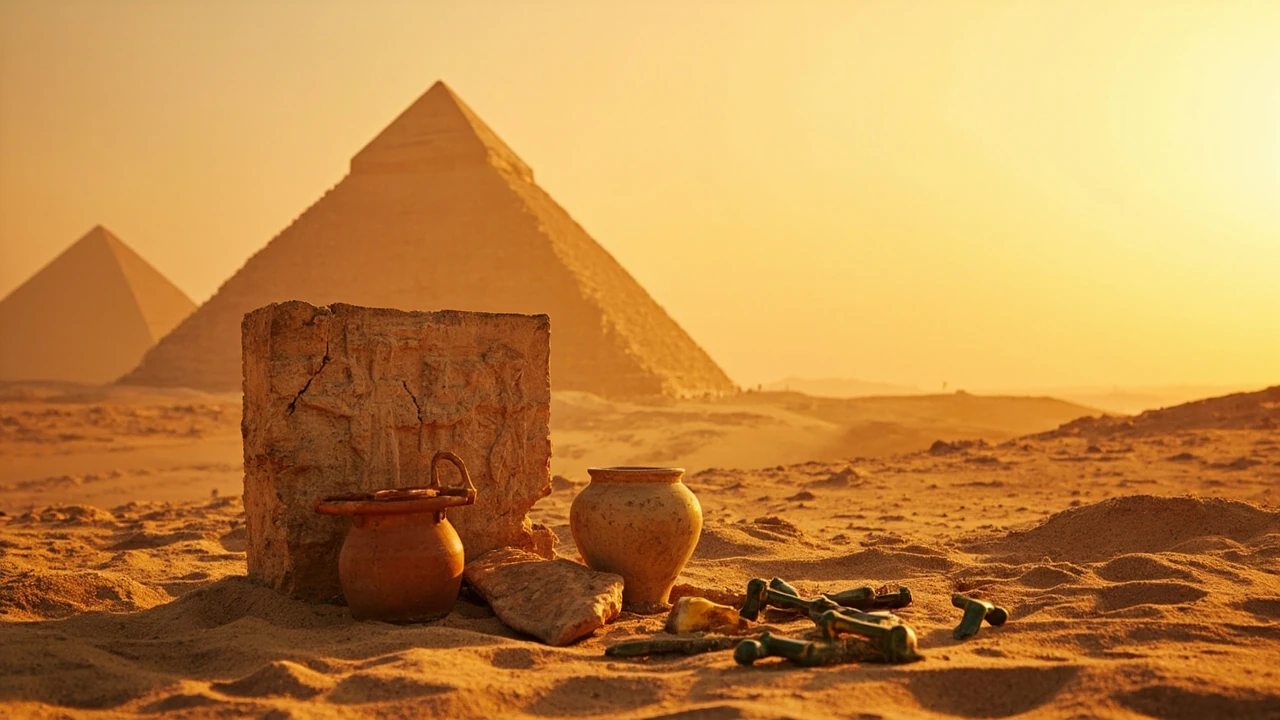
timeline of ancient egypt: periods, dates, and turning points
A date carved on a monument can appear more exact than the evidence behind it. The Great Pyramid was completed around 2560 BCE, while the beginning of a kingdom may be assigned to one year even though historians are tracing a gradual process of change. A timeline of ancient Egypt therefore has to place political events, royal reigns, material discoveries, and uncertain dates in the same historical context.
Ancient Egyptian history extends from the emergence of early kingdoms in the late fourth millennium BCE to the end of Ptolemaic rule in 30 BCE. During those three millennia, kingship, writing, art, religion, foreign relations, and the boundaries of the Nile Valley changed repeatedly. The result was not a single state in the modern sense, although Egyptian rulers and communities continued to identify themselves with the land of the Nile.
The most useful framework divides political history into the Early Dynastic, Old, Middle, New, and Third Kingdoms, separated by two Intermediate periods. Later periods include the Late Period and the Ptolemaic era. These are modern scholarly labels rather than names used by the ancient Egyptians, but they remain the clearest way to organize rulers, events, and artifacts in chronological order.
| Period | Approximate dates | Major developments | Notable rulers |
|---|---|---|---|
| Early Dynastic Period | c. 3100–2686 BCE | Political unification, royal administration, early writing, and the first monumental building projects | Narmer, Djoser |
| Old Kingdom | c. 2686–2181 BCE | Large-scale pyramid construction, centralized government, military expeditions, and expansion into Nubia | Sneferu, Khufu, Khafre, Pepi II |
| First Intermediate Period | c. 2181–2055 BCE | Weaker central authority, greater regional power, and competing centers at Herakleopolis and Thebes | Local rulers and nomarchs |
| Middle Kingdom | c. 2055–1650 BCE | Reunification, literary development, irrigation works, and renewed control of Nubia | Mentuhotep II, Senusret I, Amenemhat III |
| Second Intermediate Period | c. 1650–1550 BCE | Political division, foreign settlement in the Delta, trade, and military conflict | Seqenenre Tao, Kamose, Ahmose I |
| New Kingdom | c. 1550–1069 BCE | Imperial expansion, major temples, diplomacy, warfare, and the Amarna religious reform | Ahmose I, Hatshepsut, Thutmose III, Akhenaten, Ramesses II |
| Third Intermediate Period | c. 1069–664 BCE | Competing northern and southern governments, Libyan dynasties, and Kushite rule | Shoshenq I, Piye, Shabaka |
| Late Period | 664–332 BCE | Saite revival, renewed Egyptian dynasties, Persian conquest, and increasing Greek influence | Psamtik I, Cambyses II, Darius I |
| Ptolemaic era | 332–30 BCE | Macedonian kingship, Egyptian temples, Greek-speaking cities, and Roman annexation | Alexander, Ptolemy I, Cleopatra VII |
Before unification: communities along the Nile
The history recorded by Egypt’s royal institutions did not begin with a fully formed kingdom. Long before the first dynastic kings, communities along the Nile were farming, herding, fishing, making pottery, and exchanging materials. Predynastic burials and settlements at Naqada, Abydos, and Hierakonpolis show increasingly differentiated communities, specialized craft production, and formal ritual practices.
Between roughly 4000 and 3100 BCE, the northern Delta and the southern valley around Upper Egypt developed distinct political traditions. Kingship became more formal, royal imagery became more consistent, and seals and administrative marks appeared more widely. The later Egyptian names for Upper and Lower Egypt preserved this geographic division and became part of the royal title.
Writing changes the character of the evidence available to historians. Without written records, political development has to be reconstructed from objects, burials, settlement patterns, and art. Once writing appears, royal names and events can be attached to named reigns, although many of the surviving documents remain incomplete.
The precise date on which Upper and Lower Egypt became one kingdom remains debated. The regnal list attributed to Manetho places the beginning of the dynastic period in the era later expressed as 3100 BCE. Archaeology provides approximate boundaries rather than a documented day, so historians commonly write “around 3100 BCE.”
What made Narmer’s reign significant?
Narmer’s victory over a ruler of Lower Egypt, represented on the Narmer Palette, is generally treated as the symbolic beginning of the unified state. The palette combines royal imagery, defeated enemies, and the visual joining of two crowns. It does not demonstrate that every regional dispute ended in one battle, but it presents the victory as a decisive achievement over the whole land.
Why do Early Dynastic dates sometimes differ?
Some chronologies follow the conventional reign lengths preserved in Manetho’s work. Others use shorter dates derived from historical or archaeological estimates. The difference between two lists may amount to only a few decades or a single generation. For general reference purposes, the important point is that unification occurred at the end of the fourth millennium BCE and opened the sequence of royal dynasties.
Unification and the first great royal projects
The First and Second Dynasties established institutions that later pharaohs inherited. Royal administrators, court officials, surveyors, artists, and priests worked within a government centered on the king and the sacred royal residence. Royal tombs at Abydos and Saqqara show that burial customs became increasingly elaborate, while monumental inscriptions gave royal achievements a permanent public form.
Djoser, the first securely placed ruler of the Third Dynasty, became closely associated with the step pyramid complex at Saqqara. Its architect Imhotep was later remembered for his role in the design. The structure did not emerge as a fully rectangular pyramid. Its changing form reflects the development of Egyptian building knowledge during the early Old Kingdom.
The Fourth Dynasty brought enormous construction projects. Sneferu commissioned more than one pyramid at Dahshur, including the Bent Pyramid, before beginning the Red Pyramid. His son Khufu then sponsored the Great Pyramid at Giza, completed around 2560 BCE according to the conventional chronology. Each pyramid belonged to a wider complex containing temples, causeways, valley temples, subsidiary pyramids, cemeteries, and settlements for workers and administrators.
Other Fourth Dynasty rulers advanced royal cities and monumental tombs. Khafre’s complex included the Sphinx, while Menkaure built a smaller but still substantial pyramid complex. These projects depended on quarrying, transport, surveying, food distribution, and labor organization on a scale that can be studied through settlements and archaeological remains.
Major rulers and events in chronological order
The second table separates selected rulers from the larger periods they shaped. Dates remain approximate where the surviving chronology is uncertain.
| Approximate date | Ruler or event | Place in the chronology |
|---|---|---|
| c. 3100 BCE | Narmer and early dynastic unification | Upper and Lower Egypt are brought under a centralized royal system |
| c. 2670 BCE | Djoser and the Step Pyramid of Djoser | Early development of monumental stone architecture |
| c. 2613–2589 BCE | Sneferu | Construction projects at Dahshur, including the Bent and Red Pyramids |
| c. 2589–2560 BCE | Khufu | Completion of the Great Pyramid at Giza |
| c. 2558–2532 BCE | Khafre | Giza pyramid complex and construction of the Sphinx |
| c. 2055 BCE | Mentuhotep II | Reunification of Egypt under the Eleventh Dynasty |
| c. 1971–1926 BCE | Senusret I | Expansion of royal administration and fortified centers in Nubia |
| c. 1938–1709 BCE | Amenemhat III | Extensive building works, including the Labyrinth at Hawara |
| c. 1550 BCE | Ahmose I | Expulsion of the Hyksos rulers and restoration of a unified kingdom |
| c. 1479–1458 BCE | Hatshepsut | Expedition to Punt and extensive monumental construction |
| c. 1479–1425 BCE | Thutmose III | Campaigns in the Levant and expansion of Egyptian influence |
| c. 1353–1336 BCE | Akhenaten | Promotion of the Aten and relocation of the royal court to Amarna |
| c. 1279–1213 BCE | Ramesses II | Peace treaty with the Hittites and extensive building at Abu Simbel |
| c. 1070 BCE | Establishment of the Twenty-second Dynasty | Libyan-origin rulers establish a new center at Tanis |
| 747–656 BCE | Twenty-fifth Dynasty | Kushite rulers govern Egypt from Napata and later Memphis |
| 525 BCE | Cambyses II conquers Egypt | Egypt becomes a province of the Persian Empire |
| 332 BCE | Alexander enters Egypt | Foundation of Alexandria and the beginning of Macedonian rule |
| 305 BCE | Ptolemy I establishes the Ptolemaic dynasty | Greek Macedonian kingship is combined with Egyptian royal traditions |
| 30 BCE | Death of Cleopatra VII | Egypt is annexed by Rome and the Ptolemaic kingdom ends |
The Old Kingdom and the First Intermediate Period
The Old Kingdom, conventionally dated from about 2686 to 2181 BCE, is often called the age of the pyramids. Its Fourth Dynasty is the most familiar part, but Fifth and Sixth Dynasty rulers continued major construction, military campaigns, religious reforms, and royal projects. The step pyramid of Djoser, the pyramids of Khufu, Khafre, and Menkaure, and the pyramid complex of Unas demonstrate how funerary traditions changed across generations.
Royal power extended beyond tomb building. Kings also sponsored temples, residences, official tombs, and expeditions beyond Egypt’s core territory. Campaigns into Nubia sought control of resources and the southern frontier. Scenes in royal tombs present these undertakings as successful extensions of the king’s authority, although they reveal much less about the local leaders and communities involved.
Reforms associated with Pepi II and powerful officials including Weni and Harkhuf show that royal administration could reach distant regions. Administrative titles, biographies, and tomb decorations provide evidence for military service, resource collection, and the organization of work. These texts remain court-centered, so they show what the monarchy wanted to present rather than a complete social history.
After the reign of Merenre, the documented royal sequence became less secure. Governors known as nomarchs exercised substantial power in regions including Herakleopolis and Thebes. The First Intermediate Period was not an empty gap in the record. Local rulers maintained courts, sponsored building, fought competitors, and adopted royal titles. Older institutions continued in some areas while central government lost the ability to coordinate the entire country.
This disruption may have been connected with low Nile inundations, changing river patterns, political rivalry, and pressure from neighboring powers. No single explanation fits every region. Inscriptions, seals, pottery, and settlement evidence indicate an uneven experience: some centers remained stable while others became more militarized or politically divided.
How should the Old Kingdom’s decline be described?
“Collapse” can make the transition sound more abrupt and uniform than the evidence allows. Central authority weakened, regional governors gained autonomy, and the location of political power shifted. Institutions and settlement did not simply disappear. The First Intermediate Period is better understood as a reorganization in which control became less centralized and more regional.
The Middle Kingdom: reunification and control of the south
Around 2055 BCE, the Eleventh Dynasty ruler Mentuhotep II reunited Egypt under Theban leadership. A sequence of royal tombs at Deir el-Bahari reflects the rulers’ connection with earlier traditions, while the subsequent Twelfth Dynasty expanded Egyptian authority southward into Nubia. The Middle Kingdom is also remembered for its literature, including stories, hymns, instructions, and funerary texts written in Middle Egyptian.
Senusret I and Senusret II strengthened royal administration and organized new institutions. Senusret III extended Egyptian control farther into Nubia and constructed fortified centers along the Nile. Evidence from Buhen and other southern settlements indicates the presence of a defended frontier, although the intensity of Egyptian control changed over time and should not be treated as a fixed modern border.
Surveyors, archivists, and scribes recorded Nile flooding, agricultural production, and the movement of people and goods. Middle Kingdom accounts also preserve unusually detailed information about court life, education, and official careers. Well-known works include the story of Sinuhe and the Instructions of Amenemhat, which present an idealized view of royal service and political order.
The Twelfth Dynasty ended without an immediate successor of comparable authority. The Thirteenth Dynasty governed during a politically complicated period, while the Fourteenth Dynasty controlled much of the Delta from Avaris. The Second Intermediate Period developed as a contest among rulers based in the Delta, kings at Thebes, and other regional powers.
What happened during Egypt’s Second Intermediate Period?
Political fragmentation and foreign migration overlapped. Groups known by the Egyptian term “Hyksos” became established in the eastern Delta, where they formed a ruling center at Avaris. Theban kings such as Seqenenre Tao, Kamose, and Ahmose challenged Hyksos authority. Migration, diplomacy, trade, military conflict, and cultural exchange all belong in the history of this period.
The New Kingdom: expansion and religious change
For comparison, the broader chronology of ancient history places Egyptian unification alongside other early state formations and the first use of writing. The comparison helps show that the Nile Valley was connected to wider exchanges in materials, ideas, and political organization, even when its early development followed its own path.
The New Kingdom begins conventionally around 1550 BCE. Ahmose I defeated the Hyksos rulers, recovered control of the Delta, and began a campaign that carried Egyptian power beyond its earlier frontiers. The Seventeenth Dynasty and early Eighteenth Dynasty period brought major changes in warfare, administration, and royal representation.
Hatshepsut ruled as pharaoh and used monumental building as well as military language to establish her authority. Her trading expedition to the land of Punt, represented at Deir el-Bahari, is the best-known example, although her reign also included domestic construction and the management of court politics. She was succeeded by Thutmose III, whose campaigns in the Levant made him one of the most thoroughly documented rulers of the ancient eastern Mediterranean.
The Amarna Period followed under Amenhotep IV, later known as Akhenaten. He elevated the solar deity Aten, moved the royal residence to a new city at Amarna, and encouraged a distinctive artistic style. The period ended with the restoration of older cults, especially the prominence of Amun. Tutankhamun’s reign and the later restoration under Seti I and Ramesses II belong to a renewed imperial phase.
Ramesses II signed a peace treaty with the Hittite king Muwatalli II around 1259 BCE. The document is one of the earliest surviving international peace agreements known in detail. Ramesses also sponsored extensive building at Abu Simbel and elsewhere. Merneptah’s victory over the Libyans and Sea Peoples is recorded on the Merneptah Stele, which also contains an early reference to Israel within a much larger account of the campaign.
Late Eighteenth and Nineteenth Dynasty rulers administered an empire reaching from the eastern Mediterranean toward Nubia. Construction of the royal residence at Pi-Ramesses in the Delta required a major relocation of the administrative center. Frontier communities such as Buhen and Tombos also experienced changes in settlement, trade, and political allegiance.
- Expansion: Campaigns and diplomacy extended Egyptian influence into Palestine, the Levant, and Nubia.
- International contact: Gift exchange, marriage diplomacy, war, and treaty-making connected Egypt with powers from Anatolia to the Levant.
- Administrative reach: New residences and frontier installations supported governors, troops, and regional building projects.
- Religious change: Akhenaten’s promotion of the Aten transformed royal religion and visual culture before older traditions were restored.
From the Third Intermediate Period to Persian rule
After the death of Ramesses XI in the early eleventh century BCE, royal power fragmented. The High Priests of Amun at Thebes competed with kings based in the Delta, while rulers of Libyan origin established the Twenty-second Dynasty. Tanis became a major royal center in the north, and the Twenty-third Dynasty included kings based at several cities in Upper Egypt. The political geography was more complicated than a simple division into two kingdoms.
The Twenty-fourth and Twenty-fifth Dynasties included Kushite rulers from the kingdom of Kush to the south. Kings such as Piye and Shabaka governed Egypt while maintaining a distinct royal center at Napata and later Memphis. Kushite rule represents both Egyptian and Nubian political history rather than a brief foreign interruption followed by an automatic return to the old order.
The Twenty-sixth Dynasty revived native Egyptian kingship within a changed geopolitical environment. Sais, in the western Delta, became the capital. The dynasty expanded military power into the eastern Mediterranean and developed diplomatic relationships with Greek states. Psamtik I’s occupation of Ashdod and other coastal territories placed Egypt within the wider conflicts among Assyria, Babylon, and Persia.
In 525 BCE, Cambyses II of Persia invaded Egypt and defeated Psamtik III at the Battle of Pelusium. Darius I subsequently organized the country as a Persian possession, using local temples and administrative structures within the Achaemenid imperial system. Revolts during the later sixth century BCE show that Persian authority was never accepted without resistance.
Alexander of Macedon entered Egypt in 332 BCE after defeating Darius III at Issus. The Macedonians captured Egypt’s administrative center and founded Alexandria. Alexander died in 323 BCE, and Ptolemy I later took control of Egypt. The resulting kingdom combined Macedonian royal institutions with Egyptian kingship and a prominent place for Egyptian deities in state ritual.
When did ancient Egyptian history become Ptolemaic?
The conventional dividing point is 332 BCE, when Alexander took control, although Ptolemaic rule did not immediately replace every Macedonian arrangement. The dynasty began with Ptolemy I’s consolidation of royal authority after Alexander’s death. In 30 BCE, following the defeat and death of Cleopatra VII, Rome annexed Egypt as a province. Most historical chronologies therefore end the Ptolemaic sequence in that year.
The Ptolemaic era: Greek kings and Egyptian temples
Between 332 and 30 BCE, Egypt became one of the wealthiest and most influential kingdoms of the Hellenistic world. Ptolemaic kings were Macedonian Greeks, but they governed a predominantly Egyptian population and regularly adopted Egyptian royal traditions. They supported Egyptian cults, built monumental temples, founded Greek-speaking cities, and drew on the Nile Valley’s agricultural production to sustain armies, courts, and Mediterranean trade.
Alexandria became a center for scholarship, commerce, and government. Its library and scholarly community became famous, although surviving accounts sometimes combine historical knowledge with later legend. The Serapeum and other religious sites connected the city with wider Egyptian traditions, while the Ptolemaic court attracted artists, poets, mathematicians, and administrators from across the Mediterranean.
Egyptian temple projects expanded under Ptolemaic rulers. Karnak, the Temple of Horus at Edfu, and the Temple of Isis at Philae illustrate the scale of their resources and the importance of local religious institutions. Reliefs and architectural styles combined Egyptian iconography with Greek and Hellenistic features, but these were not simply copies of older monuments. They served contemporary communities and changed as priestly and royal traditions evolved.
Internal conflict intensified during the later kingdom. Egyptian opposition to Greek dominance became a recurring political force, while rival Ptolemaic rulers competed for the throne. Cleopatra VII allied first with Julius Caesar and later with Mark Antony. Their political and military choices led to Roman intervention. After Octavian defeated Antony and Cleopatra at Actium in 31 BCE, Egypt became a Roman province in 30 BCE.
Ancient Egypt did not cease to exist under Roman rule. Temples continued to function, local officials retained some authority, and Egyptian religious and artistic traditions remained influential. The political framework changed, however. The last native ruler of the Ptolemaic dynasty was gone, and Egypt entered a new imperial phase extending beyond 30 BCE.
How ancient Egypt fits into the wider ancient world
An Egyptian chronology becomes easier to understand when its major periods are compared with events elsewhere. The Early Dynastic Period overlapped with the first use of writing and the formation of early states in Mesopotamia. The Old Kingdom preceded the height of the Minoan civilization, while the Middle Kingdom overlapped with the early Aegean Bronze Age.
The New Kingdom coincided with the Late Bronze Age eastern Mediterranean, a period of extensive exchange among Egypt, the Levant, Cyprus, Anatolia, and the Aegean. Hittite texts mention Egyptian rulers and campaigns, while the Amarna letters preserve diplomatic correspondence once stored in Egyptian archives. These records explain why the Battle of Kadesh and the peace treaty with the Hittites matter beyond Egyptian history alone.
During the Third Intermediate and Late Periods, Egypt interacted with Phoenician city-states, Assyria, Babylonia, and Persia. Saite kingship also developed diplomatic ties with Greek states. These contacts placed Egypt within larger political shifts rather than presenting the country as an isolated civilization.
Chronology also helps travelers understand what they see in museums. A Middle Kingdom mummy, a New Kingdom temple relief, and a Ptolemaic portrait were produced under different political and religious conditions. A timeline of ancient Egypt provides a practical way to connect objects, buildings, and inscriptions with the period that produced them.
How to read dates and evidence in an Egyptian chronology
Ancient Egyptian chronology combines written records, archaeological remains, astronomical references, imported objects, and reconstructed reign lengths. Some dates rest on inscriptions or well-established sequences. Others depend on linking a king to evidence whose absolute date is uncertain. A responsible timeline may therefore present a range, a conventional date, or two competing chronologies rather than one supposedly indisputable year.
Several distinctions are especially useful. A king’s reign is not the same as the date of an event within it. The conventional beginning of a dynasty may reflect a reconstruction rather than a surviving declaration. The names of the periods are retrospective, since ancient people did not call their era the Old Kingdom or the New Kingdom in the modern sense.
BC dates also require care. A date described as 2000 BCE is earlier than 1900 BCE because the count moves toward zero. There is no year zero in the conventional BC and AD system, a small detail that matters when calculating intervals across the era boundary. When a source uses “about” or “circa,” it is identifying an approximation rather than expressing carelessness.
Material evidence also requires careful interpretation. A royal title shows that a ruler claimed a particular status, but it does not always prove that the claim was accepted throughout the country. A temple inscription records the official version of an event, while settlement patterns can reveal how ordinary communities experienced changes in trade, agriculture, and political control.
A practical way to study the chronology
- Learn the main period boundaries and the rulers associated with each dynasty.
- Connect each period to a location such as Abydos, Saqqara, Giza, Thebes, Avaris, Tanis, or Alexandria.
- Pair political events with evidence from tombs, temples, settlements, and written documents.
- Mark dates as precise, conventional, approximate, or disputed.
- Compare Egypt with neighboring regions while keeping direct evidence distinct from later interpretation.
For visitors, this approach can also connect a journey through Egypt to its chronology. The pyramid fields at Giza belong to the Old Kingdom, the temples at Karnak and Luxor largely reflect the New Kingdom, and the Serapeum at Alexandria is associated with the Ptolemaic and Roman periods. A timeline of ancient Egypt turns these stops into a connected account of political change rather than a list of isolated monuments.
Frequently asked questions
When did ancient Egypt begin?
Ancient Egypt is usually traced from the beginning of dynastic rule around 3100 BCE, when Upper and Lower Egypt were unified under early kings. Egyptian communities and precursor states existed earlier, so the starting point depends on whether the question concerns the earliest farming societies, the formation of a kingdom, or the conventional beginning of dynastic history.
How long did ancient Egypt last?
From dynastic unification around 3100 BCE to Roman annexation in 30 BCE, ancient Egyptian history spans roughly three millennia. It includes the Early Dynastic, Old, Middle, New, and Third Kingdoms, two Intermediate periods, the Late Period, and the Ptolemaic era.
What are the main periods of ancient Egyptian history?
The standard sequence is Early Dynastic, Old Kingdom, First Intermediate, Middle Kingdom, Second Intermediate, New Kingdom, Third Intermediate, Late Period, and Ptolemaic era. Some modern frameworks divide the Late Period into smaller sections, but the broader labels remain widely used in textbooks, museums, and historical reference works.
Who unified Upper and Lower Egypt?
Narmer, the early dynastic king associated with the Narmer Palette, is generally credited with uniting Upper and Lower Egypt. The process may have taken more than one generation. The palette is therefore best read as a royal statement of completed unification rather than a visual record of every stage that led to it.
When was the Great Pyramid of Giza completed?
The Great Pyramid was completed around 2560 BCE during the reign of Khufu in the Fourth Dynasty. This date comes from the wider Egyptian royal chronology rather than a modern construction label. It refers to completion of the main pyramid, not to every structure in the surrounding Giza complex.
Who ruled Egypt during the New Kingdom?
The New Kingdom included the Seventeenth Dynasty and most of the Eighteenth, Nineteenth, and Twentieth Dynasties. Major rulers included Ahmose I, Hatshepsut, Thutmose III, Akhenaten, Tutankhamun, Seti I, and Ramesses II. The period moved from reunification through imperial expansion to the reign of Ramesses II.
When did Egypt become part of the Roman Empire?
Egypt became a Roman province in 30 BCE, following the death of Cleopatra VII and the defeat of Mark Antony and Cleopatra by Octavian. Egyptian temples, officials, and religious practices continued under Roman rule, but 30 BCE marks the end of the Ptolemaic kingdom.
Why do ancient Egyptian dates differ between sources?
Differences can result from competing reign-length systems, revised archaeological correlations, or different ways of labeling uncertain transitions. Many variations are relatively small, but a list of dates can make them appear more substantial. Good timelines state whether a date is approximate, conventional, or disputed.
Were there women pharaohs in ancient Egypt?
Yes. Hatshepsut is the best-known female ruler, but she was not the only woman to exercise royal authority. Sobekneferu ruled as pharaoh in the late Twelfth Dynasty, and several women served as regents, co-regents, or powerful royal officials. Cleopatra VII was the final ruler of the Ptolemaic dynasty and the last monarch of an independent ancient Egyptian kingdom.
What was the difference between the Old Kingdom and the New Kingdom?
The Old Kingdom is associated especially with the great pyramids and strong Fourth through Sixth Dynasty monarchy. The New Kingdom began after the Second Intermediate Period and became an era of imperial expansion, major temples, international diplomacy, warfare, and religious reform. Both had powerful royal governments, but they operated at different scales and left different bodies of evidence.




Leave a Reply