
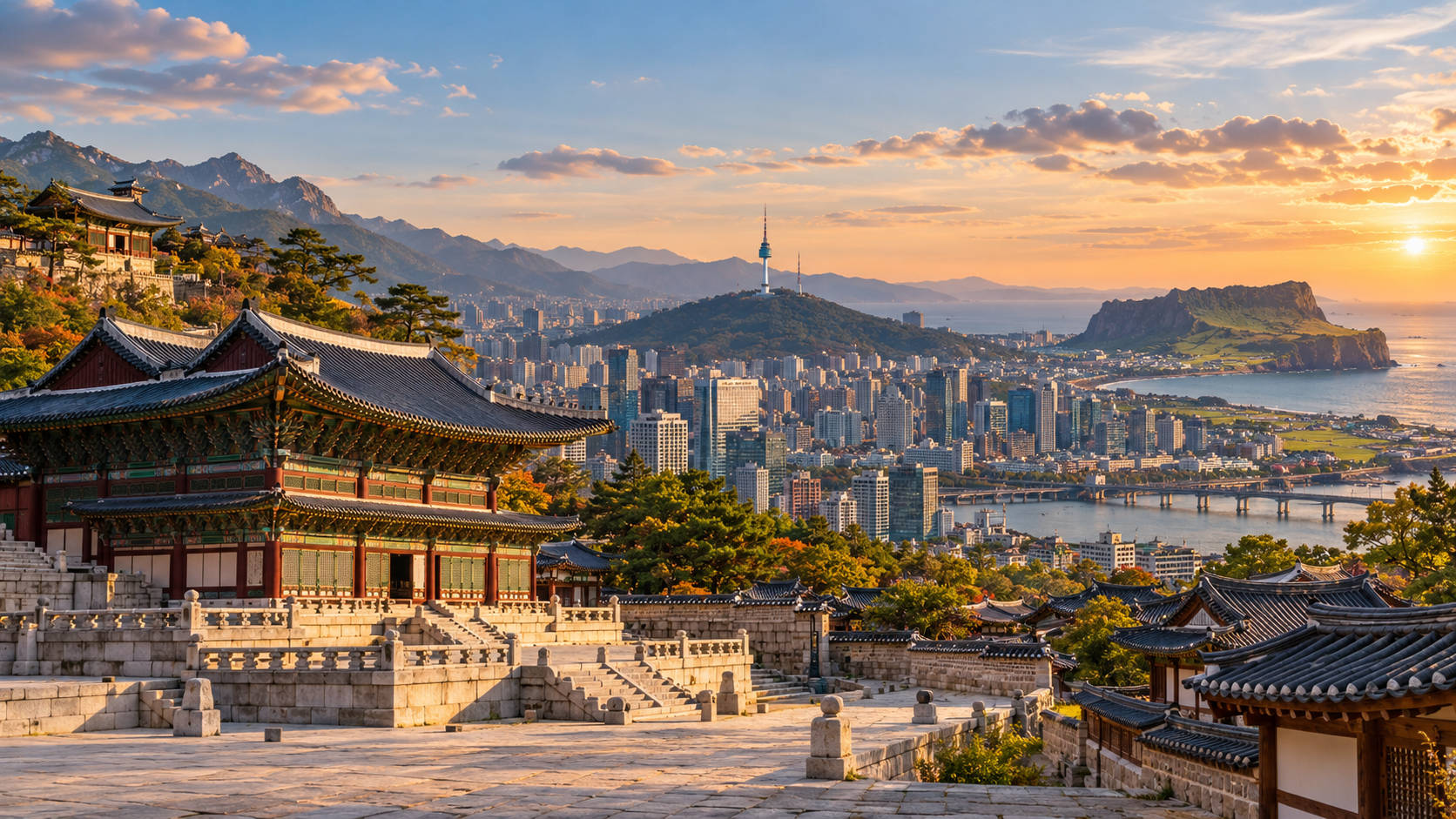
South Korea can mess with your sense of time.
You leave a subway station surrounded by giant digital screens, glass towers and cafés serving drinks that look like chemistry experiments. Ten minutes later, you are standing in front of a palace gate built in the style of the Joseon Dynasty.
Then you catch a high-speed train and end up beside royal tombs, a mountain temple or a grassy burial mound that has been there for more than a thousand years.
That contrast is the fun part.
Many first-time American visitors picture South Korea mainly through Seoul, K-pop, Korean barbecue and modern technology. Those things are real, obviously. But the country’s most interesting landmarks tell a much longer story.
There are Buddhist temples from the Silla period, fortress walls from the Joseon era, volcanic landscapes on Jeju Island, traditional hanok villages, dramatic seaside temples and some of the most densely layered historic cities in East Asia.
And South Korea is compact enough that you can actually connect many of them in one trip.
Which South Korea Landmarks Should First-Time Visitors See?
If this is your first visit, Seoul deserves several days. But stopping there would give you only one version of the country.
Gyeongju gives you royal Silla history. Jeju shows the volcanic side of Korea. Busan adds beaches and coastal temples. Suwon brings in fortress architecture. Rural areas and historic villages slow everything down.
| Landmark | Location | Best For |
|---|---|---|
| Gyeongbokgung Palace | Seoul | Joseon royal history |
| Changdeokgung Palace | Seoul | Palace architecture and gardens |
| N Seoul Tower | Seoul | City views |
| Hwaseong Fortress | Suwon | Historic walls and walking |
| Bulguksa Temple | Gyeongju | Buddhist heritage |
| Seokguram Grotto | Gyeongju | Buddhist sculpture |
| Seongsan Ilchulbong | Jeju | Volcanic scenery |
| Haedong Yonggungsa | Busan | Coastal temple views |
Gyeongbokgung Palace Is the Classic Seoul Landmark
If you only see one royal palace in Seoul, most travelers start here.
Gyeongbokgung was originally built in 1395, early in the Joseon Dynasty, and served as the dynasty’s principal royal palace.
The complex has been damaged, destroyed and reconstructed more than once during its long history.
Today, broad courtyards, ceremonial halls, gates and mountain views make it one of Seoul’s most recognizable historic sites.
The first thing you notice is scale.
This is not a cute old residence squeezed between modern buildings. The palace grounds open up dramatically once you pass through the main entrance.
Behind the tiled roofs, Bugaksan Mountain rises above the city.
It feels surprisingly calm considering central Seoul is right outside.
The Royal Guard Ceremony Is Worth Timing Your Visit Around
Traditional changing-of-the-guard ceremonies take place near the main gate on scheduled days.
The uniforms are bright. Drums echo across the courtyard. Flags move in the wind.
Yes, it is popular with tourists.
It is still worth seeing.
If you arrive early, the palace feels completely different before large tour groups appear.
Why Is Everyone Wearing Hanbok?
You will probably notice visitors walking through Seoul’s palaces in traditional-style Korean clothing known as hanbok.
Rental shops around the historic district make this easy.
For many travelers, dressing in hanbok is part of the palace experience rather than just a photo gimmick.
The colorful clothing also looks spectacular against palace architecture.
If you join in, choose something comfortable enough to walk in for a few hours.
Those palace grounds are bigger than they look on Instagram.
Changdeokgung Feels More Intimate
Gyeongbokgung is grand.
Changdeokgung feels more organic.
Built in the early 15th century, the palace was designed around the existing landscape rather than forcing the terrain into a rigid geometric plan.
Buildings follow the contours of the land, while the famous rear garden spreads into wooded hills behind the palace.
This relationship between architecture and landscape helped earn Changdeokgung recognition as a UNESCO World Heritage property.
The palace was originally a secondary royal residence, but it became particularly important during periods when Gyeongbokgung could not be used.
The Secret Garden Is the Real Highlight
The rear garden, often called the Secret Garden or Huwon, contains ponds, pavilions, trees and gently changing terrain.
It is less about one dramatic object and more about how the landscape unfolds.
A pavilion appears beside water.
A path disappears behind trees.
A small structure suddenly frames a view perfectly.
Korean palace design makes much more sense after you walk through here.
Bukchon Hanok Village Shows a Different Kind of Historic Seoul
Bukchon sits between major palace areas and preserves streets lined with traditional Korean houses called hanok.
The curved tiled roofs and narrow uphill lanes create some of Seoul’s most photographed views.
But there is a catch.
People actually live here.
Bukchon is not a movie set.
Residents have dealt with heavy visitor traffic, noise and photography for years. Respect local restrictions, keep your voice down and avoid treating every doorway as a personal photo studio.
The neighborhood becomes much nicer when visitors remember it is a neighborhood.
N Seoul Tower Gives You the Big Picture
N Seoul Tower stands on Namsan, a prominent hill near central Seoul.
From the observation areas, the city spreads in almost every direction.
This is where you finally understand how huge Seoul is.
Apartment districts stretch toward mountains. High-rises cluster around business areas. The Han River cuts through the city. Roads, parks and neighborhoods seem to keep going forever.
Come near sunset if visibility is good.
You get daylight views first, then watch the city turn into a field of lights.
Dongdaemun Design Plaza Looks Like Seoul’s Future Landed Early
Not every famous Korean landmark is ancient.
Dongdaemun Design Plaza, commonly shortened to DDP, is one of Seoul’s modern architectural icons.
The flowing metallic structure was designed by architect Zaha Hadid and opened in 2014.
Its curved surfaces feel more like a spacecraft than a conventional building.
Fashion events, exhibitions and cultural activities take place here, but even walking around the exterior is worthwhile.
Visit after dark and the architecture becomes even more dramatic.
Lotte World Tower Is Seoul at Maximum Scale
Lotte World Tower rises above southeastern Seoul and is one of the city’s easiest landmarks to identify from a distance.
The skyscraper reaches 555 meters and contains offices, retail spaces, a hotel, residences and observation areas.
Seoul Sky, near the top, offers sweeping views across the capital.
If N Seoul Tower gives you a romantic hilltop perspective, Lotte World Tower gives you the feeling that you are hovering above an enormous city model.
The DMZ Is Unlike Any Other Landmark in Korea
The Korean Demilitarized Zone stretches across the peninsula between South Korea and North Korea.
Despite the name, it is one of the most heavily controlled borders on Earth.
Tourism to approved areas can include observatories, historical sites and locations associated with the Korean War and division of the peninsula.
This is not a theme park attraction.
The political and military context remains real.
Access rules can change, tours may be altered or canceled, and certain areas can close depending on security conditions.
If you plan to go, check current access requirements shortly before your visit.
Gyeongju Is Basically an Open-Air History Book
Gyeongju was the capital of the Silla Kingdom for centuries.
Today the city contains royal tombs, palace remains, temples, pagodas and archaeological sites scattered through ordinary neighborhoods.
This creates a strange experience.
You can leave a café, cross a street and suddenly find yourself beside a grassy burial mound belonging to royalty from more than a thousand years ago.
The entire city feels layered.
Daereungwon Tomb Complex Looks Almost Too Perfect
Large grass-covered burial mounds rise from the landscape in central Gyeongju.
From a distance, they look like smooth green hills.
They are ancient tombs.
The Silla elite were buried with valuable objects, including jewelry, weapons and decorative items.
Some excavated artifacts are displayed in museums today.
The area is particularly beautiful during spring and fall, when the colors around the mounds change dramatically.
Cheomseongdae Is Small but Historically Important
Cheomseongdae is one of the best-known structures in Gyeongju.
The stone tower dates to the Silla period and is traditionally described as an astronomical observatory.
Do not expect something enormous.
It is modest in height.
Its significance comes from age and historical context rather than sheer scale.
At night, lighting around the surrounding historic area creates a particularly attractive walk.
Bulguksa Temple Is One of Korea’s Great Buddhist Sites
Bulguksa stands on the slopes of Mount Toham outside central Gyeongju.
The temple’s origins go back to the Silla period, and major construction was completed during the 8th century.
Stone stairways, terraces, pagodas and wooden halls create one of Korea’s most celebrated Buddhist architectural complexes.
The layout feels balanced without being sterile.
Different levels reveal new views as you climb.
Autumn is especially popular because colorful leaves frame the traditional roofs.
Seokguram Grotto Is Small, Quiet and Extraordinary
Higher on Mount Toham, Seokguram contains a monumental stone Buddha surrounded by carved religious figures.
The grotto was created in the 8th century and is considered a masterpiece of East Asian Buddhist art.
Bulguksa Temple and Seokguram Grotto are recognized together as a UNESCO World Heritage property.
The interior experience is restrained.
You are not wandering through dozens of chambers.
Instead, the focus is concentrated on one carefully constructed sacred space.
That simplicity gives the place its power.
Why Gyeongju Deserves More Than a Day Trip
- Explore Daereungwon and the royal tomb area slowly.
- Visit Bulguksa and Seokguram in the morning.
- Walk around Wolji Pond after dark.
- See artifacts from Silla history at the national museum.
- Rent a bike for the flatter historic areas.
- Stay overnight when the major tour buses leave.
One day works.
Two days feels much better.
Hwaseong Fortress Makes Suwon an Easy Escape From Seoul
Suwon lies south of Seoul and can be reached without turning the trip into a major expedition.
The city’s most famous landmark is Hwaseong Fortress.
Built in the late 18th century under King Jeongjo, its walls stretch for nearly six kilometers around part of central Suwon.
The fortress combines defensive architecture with gates, towers, command posts and sections following the natural terrain.
UNESCO recognizes it for its unusual blend of East Asian and Western military ideas.
The best way to understand it is on foot.
Walk a section of the wall rather than simply photographing one gate and leaving.
Haedong Yonggungsa Is the Temple Everyone Wants to Photograph
Most traditional Korean temples sit in mountains.
Haedong Yonggungsa in Busan takes a different approach.
The complex occupies a rocky stretch of coastline facing the sea.
Temple buildings, stone steps and statues spread along cliffs above the water.
Waves crash below.
Morning light can be beautiful here.
So can crowds.
Arrive early.
Busan’s Gamcheon Culture Village Brings the Color
Gamcheon is built across steep hills overlooking Busan.
Rows of colorful houses climb upward in tight layers, connected by stairways and narrow alleys.
The neighborhood’s present tourism identity grew through community art projects and regeneration efforts.
Murals, viewpoints and small cafés now draw large numbers of visitors.
Once again, though, people live here.
Quiet streets are not automatically public photo studios.
Haeundae Shows South Korea’s Beach-City Side
Haeundae Beach is one of Busan’s best-known urban landmarks.
Behind the sand, skyscrapers and hotels create a skyline that feels completely different from historic Gyeongju.
Summer brings crowds.
Outside peak beach season, it becomes a pleasant waterfront walking area.
Busan works well because temples, markets, beaches and modern architecture all sit within the same metro area.
Jeju Island Is South Korea’s Great Natural Landmark
Jeju sits south of the Korean mainland and feels different almost immediately.
The island was shaped by volcanic activity.
Lava formations, craters, cliffs and unusual geological landscapes appear across the island.
Jeju Volcanic Island and Lava Tubes is a UNESCO World Heritage property, recognizing several outstanding natural features.
The island deserves at least three days.
Four or five is better if nature is the main reason you are visiting Korea.
Seongsan Ilchulbong Is the Sunrise Peak
Seongsan Ilchulbong rises dramatically from Jeju’s eastern coastline.
The volcanic tuff cone has a broad crater at the top and steep cliffs facing the sea.
Its Korean name is commonly translated as Sunrise Peak.
And yes, people wake up very early for that sunrise.
The climb is relatively short but contains plenty of stairs.
You will notice that Korea has a special talent for turning beautiful viewpoints into stair workouts.
Hallasan Dominates Jeju
Hallasan is the massive shield volcano occupying the center of Jeju Island.
At 1,947 meters, it is the highest mountain in South Korea.
Several hiking routes explore its slopes, while summit access depends on trail rules, weather and current reservation systems.
Conditions change dramatically with elevation.
A warm morning near the coast does not guarantee the same weather higher up.
Bring layers.
Manjanggul Shows What Happened Under the Lava
Jeju’s volcanic story is not only visible above ground.
Lava tube systems formed when the outer surface of flowing lava cooled while molten lava continued moving below.
This created underground tunnels.
Jeju’s lava tubes are internationally important geological features.
Public access to individual caves can change because of conservation work or safety restrictions, so check current opening conditions before planning around one specific site.
Jeju’s Dol Hareubang Are Everywhere
You will see stone grandfather statues, known as dol hareubang, across Jeju.
The volcanic stone figures have broad faces, large eyes and distinctive hats.
Historic examples are associated with old fortress gates, while modern versions now appear outside museums, hotels, shops and gardens.
Yes, souvenir versions exist.
Many souvenir versions.
Hahoe Folk Village Feels Like Stepping Into a Different Korea
Hahoe in Andong preserves traditional architecture associated with a historic clan village.
Hanok houses, tiled roofs, thatched buildings and narrow lanes sit within a landscape shaped by the Nakdong River and surrounding hills.
The village is part of the UNESCO-listed Historic Villages of Korea together with Yangdong.
It is also connected with traditional mask culture and performances.
If Seoul shows you modern Korea and Gyeongju shows you royal Korea, Hahoe gives you a stronger sense of older rural social structure.
Haeinsa Temple Protects an Extraordinary Buddhist Treasure
Haeinsa sits on Gayasan Mountain and is one of Korea’s most important Buddhist temples.
Its most famous treasure is the Tripitaka Koreana, a vast collection of Buddhist texts carved onto tens of thousands of wooden printing blocks.
The historic repository buildings were designed to preserve the woodblocks through carefully managed natural ventilation and environmental conditions.
The depositories themselves are recognized as a UNESCO World Heritage property.
This is one of those landmarks that becomes much more impressive once you understand what is being preserved.
The Royal Tombs Are Quietly Some of Korea’s Best Historic Places
The royal tombs of the Joseon Dynasty are spread across numerous locations, many around Seoul and nearby Gyeonggi Province.
They combine burial architecture with carefully selected natural landscapes.
Forest, grass-covered burial mounds, ceremonial paths and stone figures create an atmosphere very different from busy palace complexes.
If you need a break from Seoul crowds, these sites can be surprisingly peaceful.
Jongmyo Shrine Is About Ritual More Than Decoration
Jongmyo in Seoul was built for royal ancestral rites connected with the Joseon Dynasty.
The architecture is intentionally restrained.
Long, low buildings and large courtyards dominate the complex.
Do not arrive expecting palace-level ornament.
The visual simplicity is part of the point.
The site reflects Confucian ritual traditions and remains one of Korea’s major UNESCO-listed cultural landmarks.
Namhansanseong Combines Mountains and Military History
Namhansanseong sits in mountainous terrain southeast of Seoul.
The fortress historically served as an emergency defensive capital during the Joseon period.
Today, visitors come for hiking as much as history.
Walls follow forested ridges, giving you mountain views along with gates and defensive structures.
It is one of the better choices if your travel companions disagree about whether the day should involve culture or hiking.
You get both.
What About the Newer UNESCO Sites?
South Korea’s World Heritage list keeps expanding.
One of the most recent additions is the group of petroglyph sites along Bangucheon Stream, added to the UNESCO World Heritage List in 2025.
The carvings preserve ancient images associated with prehistoric communities and include remarkable depictions of animals and human activity.
They are a reminder that Korean heritage does not begin with palaces and dynasties.
The timeline goes much farther back.
Best Landmarks by Travel Style
| If You Love… | Go Here | Why |
|---|---|---|
| Royal history | Gyeongbokgung, Changdeokgung | Joseon palaces and court culture |
| Buddhist heritage | Bulguksa, Seokguram, Haeinsa | Temples, sculpture and sacred architecture |
| Nature | Jeju, Hallasan, Seongsan Ilchulbong | Volcanoes and dramatic landscapes |
| City views | N Seoul Tower, Lotte World Tower | Huge urban panoramas |
| Fortresses | Hwaseong, Namhansanseong | Walls, gates and hiking |
| Traditional villages | Hahoe, Bukchon | Hanok architecture |
How Many Days Do You Need for South Korea?
Seven days is enough for Seoul plus one additional region.
Ten days opens things up.
Two weeks is much more comfortable if you want Seoul, Gyeongju, Busan and Jeju.
A sensible first itinerary might look like this:
- Spend four days in Seoul for palaces, neighborhoods and modern landmarks.
- Take a day trip to Suwon or the DMZ, depending on current access.
- Stay two nights in Gyeongju.
- Spend two or three nights in Busan.
- Add three or four nights on Jeju if your schedule allows.
Yes, South Korea has excellent transportation.
No, that does not mean you need to change hotels every night.
High-Speed Trains Make Landmark Hopping Surprisingly Easy
South Korea’s rail system makes major city travel straightforward.
High-speed KTX trains connect Seoul with cities such as Busan and areas near Gyeongju.
For American visitors used to domestic air travel between distant cities, this can feel refreshing.
Arrive at the station.
Get on the train.
Go very fast.
Get off in another major city.
No airport drama required.
When Is the Best Time to See Korean Landmarks?
Spring and fall are the obvious favorites.
Spring brings flowering trees and comfortable walking weather.
Fall turns mountain areas and temple surroundings red, orange and gold.
Summer can be hot, humid and rainy.
Winter gets genuinely cold, especially in Seoul and inland regions, but clear winter skies can make palace photography beautiful.
Jeju is generally milder than Seoul, though wind can make coastal weather feel colder than expected.
Cherry Blossom Season Is Beautiful but Busy
Cherry blossoms typically appear in southern areas first and move northward as temperatures warm.
Exact timing changes every year.
If blossoms are the main reason for your trip, do not book around an old calendar and assume nature has accepted the appointment.
Follow seasonal forecasts close to departure.
Autumn May Be Even Better
Late October and early November often bring excellent foliage to many parts of the country, though timing varies by elevation and latitude.
Mountain temples become especially scenic.
Places like Bulguksa, national parks and palace gardens can look spectacular.
The weather is often pleasant enough for long walking days too.
Small Etiquette Details Matter
- Speak quietly inside temples and sacred halls.
- Follow photography restrictions where signs prohibit cameras.
- Do not enter private areas in residential hanok neighborhoods.
- Remove shoes where required.
- Expect some historic buildings to have limited interior access.
- Check reservation systems before popular hiking routes.
- Carry water during palace and fortress walks in hot weather.
None of this is difficult.
Mostly, do not behave like the entire country was constructed as a backdrop for your phone.
FAQ About South Korea Landmarks
What is the most famous landmark in South Korea?
Gyeongbokgung Palace is one of the country’s most recognizable historic landmarks, especially for first-time visitors to Seoul. N Seoul Tower and Jeju’s Seongsan Ilchulbong are also widely recognized.
How many UNESCO World Heritage Sites does South Korea have?
As of 2026, the Republic of Korea has 17 properties on the UNESCO World Heritage List, including cultural sites such as Changdeokgung and Bulguksa as well as natural sites such as Jeju Volcanic Island and Lava Tubes.
What landmarks should I see in Seoul?
Start with Gyeongbokgung Palace, Changdeokgung Palace, Bukchon Hanok Village, Jongmyo Shrine, N Seoul Tower and one modern site such as Dongdaemun Design Plaza or Lotte World Tower.
Is Gyeongju worth visiting?
Absolutely. Gyeongju is one of South Korea’s best destinations for history, with royal tombs, Buddhist temples, archaeological remains and major Silla-era landmarks spread across the city.
What is the best natural landmark in South Korea?
Jeju Island has several of the country’s strongest natural landmarks, including Hallasan, Seongsan Ilchulbong and major volcanic formations associated with the UNESCO-listed Jeju Volcanic Island and Lava Tubes.
Can you visit the DMZ from Seoul?
Organized tours commonly operate from Seoul, but access rules can change because the border remains an active security zone. Check current tour conditions shortly before your visit.
How many days should I spend in South Korea?
Ten days works well for Seoul plus two additional regions. Around two weeks gives you enough time to include Seoul, Gyeongju, Busan and Jeju without making every day feel like a transportation challenge.
The Best South Korea Landmarks Are About Contrast
South Korea does not force you to choose between old and new.
They sit beside each other.
That is what makes traveling here so addictive.
You can begin the morning inside a Joseon palace courtyard, surrounded by tiled roofs and mountains.
By lunch, you are eating in a shopping district where every wall seems to contain a digital screen.
Later, you ride an elevator hundreds of meters above Seoul and watch the city stretch toward the horizon.
Then a few days later, you are standing in Gyeongju beside a burial mound created for royalty from a kingdom that vanished more than a thousand years ago.
The contrasts keep piling up.
A quiet Buddhist grotto and a packed KTX train.
A volcanic crater on Jeju and a skyscraper in Seoul.
A seaside temple in Busan and fortress walls in Suwon.
A traditional hanok roof with apartment towers visible beyond it.
This is why the best south korea landmarks are not just isolated attractions.
Together, they explain the country.
Gyeongbokgung tells the story of royal authority.
Changdeokgung shows how architecture worked with landscape.
Bulguksa and Seokguram reveal the artistic sophistication of Silla Buddhism.
Gyeongju turns an ancient capital into a living modern city.
Hwaseong shows military architecture adapting new ideas.
Jeju takes the timeline back even further, into volcanic history written directly into rock.
And Seoul’s modern towers remind you that South Korea did not stop building remarkable landmarks when the dynasties ended.
If you have limited time, start with Seoul, Gyeongju and either Busan or Jeju.
If you have two weeks, slow down.
Walk the fortress walls.
Stay until evening at the palace areas.
Wake up early for a coastal sunrise.
Spend enough time in Gyeongju that the royal tombs stop feeling like individual attractions and begin to feel like part of the landscape.
Take the train instead of rushing through airports.
And leave room for places you did not plan.
Because South Korea’s famous landmarks are impressive.
But sometimes the thing you remember most is the view between them.
Leave a Reply